




PhD Courses in India: Eligibility, Entrance Exams, Admission Process and Duration
A PhD (Doctor of Philosophy) is a research degree for students who want to study a subject in depth and add something new to it. Unlike most postgraduate courses, a large part of a PhD is independent research, done under the guidance of a supervisor.
In India, you can start a PhD after an eligible master's degree. In some cases, you can also apply straight after a four-year bachelor's degree. Depending on the university and subject, admission may be through UGC-NET, CSIR-UGC NET, GATE or the university's own selection process.
This guide covers the PhD courses available in India, who can apply, how admission works and how long the degree takes. It also looks at fees, funding and research opportunities.
What Is a PhD Course in India?
A PhD is a doctoral degree in which a student studies a specific question or problem through research. Bachelor's and master's programmes mainly build knowledge and skills in a subject. A PhD goes a step further, as the student is expected to contribute something new to the field.
Take a student doing a PhD in Environmental Science. They might study how agricultural chemicals affect groundwater quality. That would mean reviewing existing research, collecting evidence, analysing the results and explaining what the study adds to what is already known.
The research is done under a supervisor, usually an experienced faculty member. Once the PhD is awarded, the graduate can use the title "Dr."
List of PhD Courses in India by Stream
PhD programmes are offered in Science, Engineering, Commerce, Management, Humanities and many other fields. Most students choose a discipline that matches their academic background and research interests.
Stream | Examples of PhD Disciplines |
Science | Physics, Chemistry, Mathematics, Biotechnology, Environmental Science |
Engineering and Technology | Computer Science, Mechanical Engineering, Electrical Engineering, Civil Engineering |
Commerce and Management | Commerce, Management, Finance, Marketing |
Humanities and Social Sciences | English, History, Psychology, Sociology, Economics, Political Science |
Education and Law | Education, Law |
Health and Allied Sciences | Pharmaceutical Sciences, Public Health, Biomedical Sciences |
Interdisciplinary Research | Computational Biology, Bioengineering, Data Science, Climate Studies, Public Policy, Digital Humanities |
The table covers some of the PhD disciplines available in India. Universities may use different names for their programmes, and some also offer specialised or interdisciplinary PhDs, such as Artificial Intelligence and Data Science.
A PhD programme covers a broad subject, but students usually focus their research on a smaller area within it. For example, someone pursuing a PhD in Computer Science might choose artificial intelligence and study how machine learning can solve a particular problem.
PhD Eligibility Criteria in India
Most students apply for a PhD after a master's degree. Under UGC regulations, students with an eligible four-year bachelor's degree can also apply directly.
Minimum Educational Qualifications and Marks
Qualification | Minimum Marks (General Category) |
Two-year master's after a three-year bachelor's | 55% |
One-year master's after a four-year bachelor's | 55% |
Eligible four-year bachelor's for direct PhD admission | 75% |
Under UGC rules, a relaxation of 5 percentage points, or an equivalent grade, may apply to eligible SC, ST, OBC (non-creamy layer) and EWS candidates, persons with disabilities and other specified categories.
Can You Pursue a PhD Directly After Graduation?
Yes, but it depends on the length and type of your undergraduate degree.
A student who completes an eligible four-year BSc or BTech with the required marks can apply directly to a suitable PhD programme, without doing a master's first.
With a regular three-year bachelor's degree, you will usually need to complete an eligible master's programme before applying.
Direct admission after a four-year degree is not automatic, though. The university has to accept your qualification for the programme you are applying to, and it may have its own entrance or selection requirements.
Is Work Experience Required?
For a regular full-time PhD, work experience is generally not needed. If you meet the academic and admission requirements, you can apply without having held a job.
Some sponsored or working-professional categories are different. These may ask for work experience and approval from your employer.
Important: Meeting the minimum academic requirements only means you can apply. Whether you get admission depends on the university's selection process and the research positions available.
PhD Entrance Exams in India
There is no single entrance exam for every PhD course in India. The exam you need depends on your research discipline and the university you want to join.
Entrance Exam / Selection Route | Commonly Relevant For |
UGC-NET | Commerce, Education, Humanities, Social Sciences and other UGC-NET subjects |
Joint CSIR-UGC NET | Chemical, Life, Mathematical, Physical and Earth-related Sciences |
GATE | Engineering, Technology, Science and other disciplines accepted by participating institutes |
Institution-specific selection | Programmes that use university-level entrance tests, screening or interviews under applicable rules |
These are common admission routes, not fixed exams for every PhD discipline. Universities may accept different examinations for the same subject.
UGC-NET: What Do the Three Qualification Categories Mean?
The National Testing Agency (NTA) conducts UGC-NET to determine eligibility for the Junior Research Fellowship (JRF), Assistant Professor positions and PhD admission.
JRF provides financial support to eligible researchers. Candidates qualify under one of three categories based on their examination results and the applicable cut-offs.
Category | What It Means |
Category 1 | Eligible for JRF, Assistant Professor and PhD admission |
Category 2 | Eligible for Assistant Professor and PhD admission, but not JRF |
Category 3 | Eligible for PhD admission only |
Candidates qualifying for UGC-NET based on a four-year bachelor's degree can become eligible for JRF and PhD admission, but not for appointment as an Assistant Professor on that qualification alone.
For candidates qualifying under Categories 2 and 3, universities give 70% weightage to NET marks and 30% to the interview or viva voce.
For PhD admission, NET scores under Categories 2 and 3 remain valid for one year from the date of result declaration.
Candidates qualifying under Category 1 follow the applicable JRF-based admission route, which involves an interview. Qualifying for JRF does not itself guarantee admission or immediate fellowship payments.
Official website: NTA UGC-NET
Joint CSIR-UGC NET
Joint CSIR-UGC NET is mainly relevant for students interested in research in science subjects such as Chemistry, Life Sciences, Mathematics, Physics and Earth Sciences.
Like UGC-NET, it has three qualification categories covering JRF eligibility, Assistant Professor eligibility and PhD admission. The corresponding rules on the 70:30 admission weighting and one-year score validity apply to Categories 2 and 3.
For example, an MSc Chemistry graduate planning doctoral research may consider Joint CSIR-UGC NET if their preferred university accepts it.
Official website: Joint CSIR-UGC NET
GATE for PhD Admission
The Graduate Aptitude Test in Engineering (GATE) is accepted for eligible doctoral programmes at institutions such as IITs and IISc.
GATE is commonly associated with engineering, but it also covers several science, humanities and social science subjects.
A GATE score remains valid for three years. However, having a valid score does not guarantee PhD admission. Universities may also conduct interviews or other screening before making offers.
Eligible GATE-qualified candidates may receive financial assistance through institutional assistantships or other research funding schemes. Unlike UGC-NET and CSIR-UGC NET, GATE does not use the three JRF, Assistant Professor and PhD admission qualification categories.
Official website: GATE
How Do You Know Which Exam to Take?
Start by shortlisting universities that offer PhD programmes in your preferred subject. Check their admission requirements to find out which entrance exams they accept.
For example, a student interested in a PhD in English may consider UGC-NET, while someone applying for Engineering research at an IIT may need GATE or another accepted qualification.
Check the department's latest admission notification to understand the complete selection process.
PhD Admission Process in India: Step by Step
PhD admission works differently from regular college admission. Along with your academic record, universities look at your research interests and whether a supervisor is available in your area.
The process usually follows these steps.
Step 1: Choose Your Research Area
Begin with the subject you want to study and find a research area within it that interests you.
If you are interested in renewable energy, for example, you might look for research on solar power, battery technology or energy storage.
Then shortlist universities whose departments and faculty members work in those areas.
Step 2: Check University Admission Notifications
Universities publish PhD admission notifications on their official websites. These usually cover:
- Departments and research seats available
- Academic eligibility and accepted entrance exams
- Application deadlines and fees
- Selection procedures and interview dates
Note that a university may offer a PhD in your discipline but have no vacancies in your specialisation in a particular admission cycle.
Step 3: Submit the Application
Apply through the university's admission portal. You will usually need your academic records, exam scores and any other documents listed in the notification.
Documents commonly asked for include degree certificates, mark sheets, identity proof, category certificates (where applicable) and your entrance exam scorecard.
Some programmes may also ask for a statement of research interests, a research proposal or a No Objection Certificate (NOC) from your employer.
Step 4: Attend the Selection Process
Shortlisted applicants may be called for an interview, a written screening test or a discussion of their research proposal, depending on the programme.
Faculty members may ask about your academic background, any previous projects and the area you want to research.
If a research proposal is required, be ready to explain what question you want to study, why it matters and how you might go about it.
You do not need to have finished any research before applying. Universities also differ on when they ask for a formal proposal.
Step 5: Complete Admission and Registration
Selected candidates need to complete document verification, pay the fees and go through the university's registration process.
A research supervisor is then allotted according to the institution's rules. Some universities ask applicants to identify possible supervisors before admission, while others allot supervisors later.
Types of PhD Programmes in India
Not every PhD is structured the same way. Universities offer a few different formats, and the right one usually depends on your academic background and whether you are currently working.
Type | How It Works |
Full-time PhD | Research and coursework are your main focus. Eligible scholars may get a fellowship or assistantship. |
Part-time PhD | Meant for eligible working professionals, who keep their jobs while completing the research and coursework requirements. |
Integrated PhD | Advanced study and doctoral research are combined into one programme. Some institutes admit students straight after a bachelor's degree. |
Sponsored PhD | The candidate is supported by an employer or another organisation, and the institution's conditions apply. |
Can You Pursue a PhD While Working?
You can, as long as the university offers a recognised part-time PhD and you meet its requirements.
UGC regulations ask employed applicants for a No Objection Certificate (NOC) from their employer. In it, the employer confirms that you are allowed to do part-time research and that you will get enough time for the academic work.
On top of this, some universities set their own conditions, for example on work experience, research facilities or how often you need to be on campus.
Are Online or Distance PhD Programmes Recognised?
No. The UGC PhD Regulations, 2022 do not allow universities, or the research institutions covered by these rules, to offer a PhD in online or distance mode.
It helps to be clear on one point here. A part-time PhD is not an online PhD. Part-time scholars still carry out supervised research and complete the same academic requirements.
So if you see a programme advertised as an "online PhD" or "distance PhD", look into its recognition carefully before you enrol.
PhD Course Duration in India
A PhD in India takes a minimum of three years, and this includes coursework. Under UGC regulations, the standard maximum is six years from the date of admission.
Duration Provision | Period |
Minimum PhD duration | 3 years |
Standard maximum | 6 years |
Extension through re-registration | Up to 2 more years, subject to university rules |
Additional relaxation for female scholars and persons with more than 40% disability | Up to 2 further years, subject to UGC conditions |
In practice, this means a PhD can stretch to eight years with the general extension. Scholars who qualify for the additional relaxation can take up to ten years.
These extensions are not automatic. They depend on the university's rules.
Integrated PhD programmes can work differently because they combine advanced coursework with research. If you are considering one, ask the institution how long it is expected to take.
What Happens During a PhD Programme?
A PhD does not follow the pattern of a regular postgraduate course. There are classes at the beginning, but most of the time goes into research on one topic, often for several years. The work can be divided into three stages.
1. Coursework and Research Preparation
PhD programmes include coursework to prepare students for research. UGC regulations require at least 12 credits, including research methodology and research and publication ethics. This stage helps students learn how to plan and carry out research properly.
2. Research Under Supervision
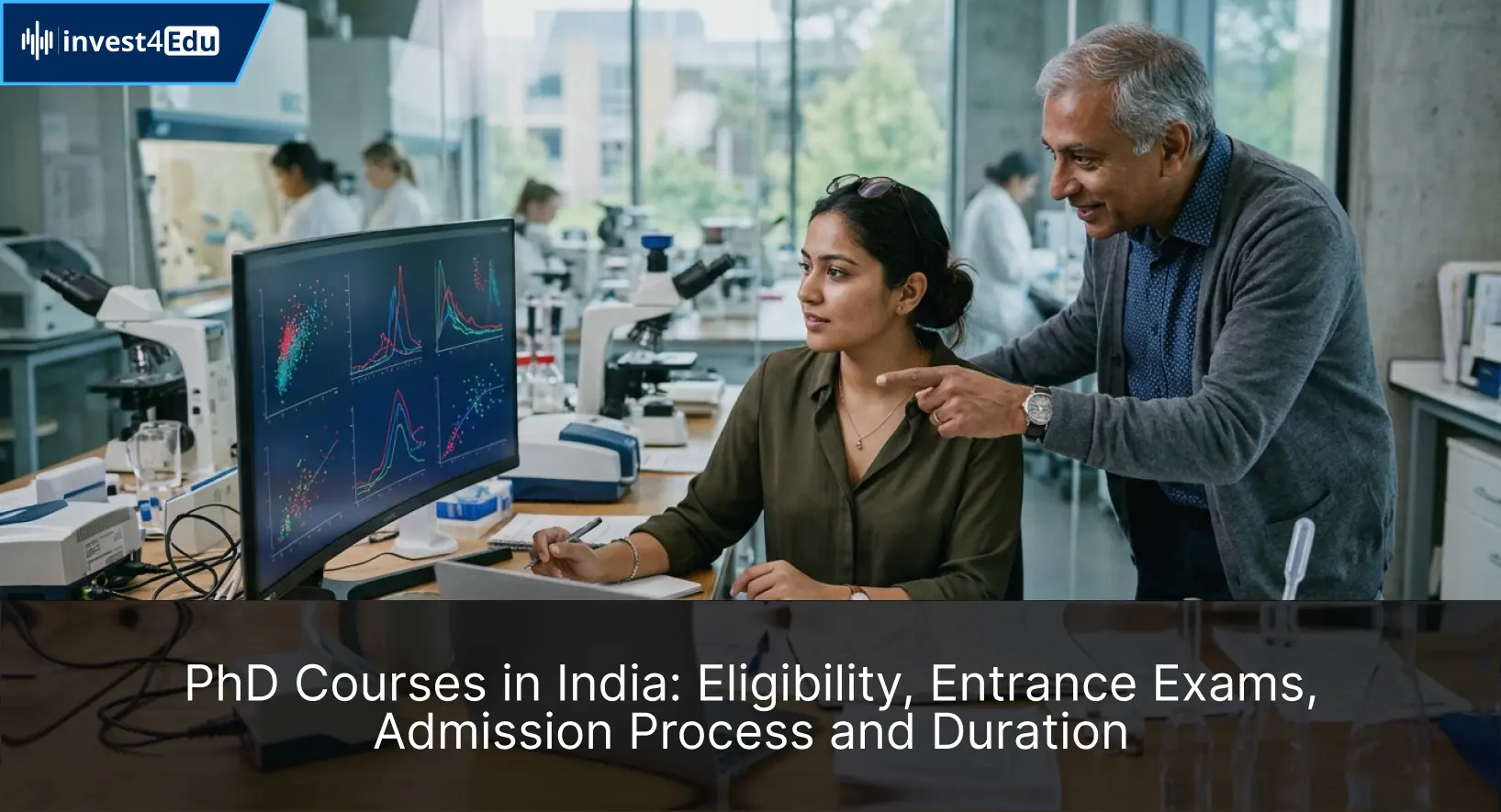
Next comes the research itself. The methods differ from subject to subject. Science students may run experiments in a lab. Someone in history may spend time in archives, and a social science scholar may do fieldwork or conduct interviews. Many projects also involve analysing data.
Throughout this period, the scholar works closely with the supervisor. A Research Advisory Committee also reviews their progress from time to time.
3. Thesis Submission and Viva Voce
When the research is finished, the scholar writes the thesis. This document explains the methods used, the results and how the work adds to the subject.
Examiners then evaluate the thesis, and the scholar defends it in a viva voce. The PhD is awarded only after all these requirements are met.
Universities and Institutes Offering PhD Courses in India: Fees and Research Areas
PhD programmes are offered by universities and research institutes across India. The fees vary by institution, programme and admission category. Here are some major government-funded institutions, their research areas and available 2026–27 PhD tuition or funding details.
University / Institute | Examples of Research Areas | Published 2026–27 PhD Tuition / Funding |
Science, Engineering, Interdisciplinary Research | ₹20,000 per year; General/EWS/OBC category | |
Engineering, Science, Management, Humanities | ₹7,500 per semester; full-time PhD category | |
Engineering, Sciences, Management, Social Sciences | ₹3,750/semester (Group I); ₹25,000/semester (Group II) | |
Humanities, Social Sciences, Languages, Sciences | ₹240 per year; general PhD tuition, exceptions apply | |
Commerce, Law, Education, Science, Humanities | Check the applicable departmental fee schedule | |
Sciences, Computer Science, Languages, Social Sciences | ₹5,090 per semester for listed PhD programmes | |
Biology, Chemistry, Physics, Mathematics, Earth Sciences | ₹29,282 for August 2026 semester; category exemptions apply | |
Engineering, Science, Architecture, Management | ₹7,500 per semester; applicable general-category tuition | |
Management, Finance, Marketing, Economics, Organisational Behaviour | Tuition covered under its doctoral financial-assistance package |
These figures refer to tuition fees or the stated funding arrangement, not the total cost of a PhD. Students may also have to pay registration, examination and other charges, along with accommodation and living expenses.
Before accepting an offer, check the latest fee structure and available financial support on the institution's official website.
This is not a ranking. Research areas, admission rules, fees and available seats may change from one admission cycle to the next.
PhD Scholarships, Fellowships and Stipends in India
Many PhD students are supported financially during their research. This support can come from government fellowships, university assistantships or funded research projects.
Two terms come up often. A fellowship is the financial support itself, given to an eligible researcher. The stipend is the monthly amount paid under that fellowship.
UGC-JRF and CSIR-JRF
If you qualify for the Junior Research Fellowship through the relevant NET exam, you may receive financial support while doing your PhD.
The published monthly rates are:
Fellowship Stage | Monthly Amount |
Junior Research Fellowship (JRF) | ₹37,000 |
Senior Research Fellowship (SRF) | ₹42,000 |
A JRF can be upgraded to an SRF later. This happens after your research progress is assessed and you meet the fellowship conditions.
JRF is not the only option. Institutions offer teaching and research assistantships, some scholars are funded through sponsored research projects, and there are fellowships such as the Prime Minister's Research Fellowship (PMRF). Each comes with its own eligibility rules and current terms.
Does Every PhD Student Receive a Stipend?
No. Getting a PhD seat does not automatically mean you will get a fellowship. The two are separate.
If you are admitted to a funded full-time programme, you may receive financial support. If your PhD is self-funded or part-time, you may need to meet your own costs.
Before joining, find out a few things. Is the funding confirmed? How long will it last? What conditions are attached, and does it cover tuition or research expenses?
How to Choose the Right PhD Programme and Research Supervisor
Choosing a PhD programme is not just about the university's reputation. You will spend several years researching one subject, so the supervisor you work with and the facilities available to you are just as important.
Before you apply, it helps to think through a few questions:
- Research fit: Is the department working on the topic you want to study?
- Supervisor expertise: Do faculty members have research experience and publications in your area?
- Supervisor availability: Are they taking on new research scholars this year?
- Research facilities: Will you have access to the labs, equipment, databases or other resources your work needs?
- Funding: Is a fellowship available? If not, which costs will you have to cover yourself?
A good place to start is the faculty profiles on the university website. If the university allows it, you can also write to potential supervisors or speak to current PhD scholars about what the department is like.
A well-known university can open many doors. Even so, the best PhD programme for you is one where your research interests, the supervision available and your financial situation all match.
Career Opportunities After a PhD in India
What you do after a PhD depends on your subject and qualifications. Graduates go into academia, research organisations, government institutions and industry.
Common paths include:
- University teaching: Applying for faculty posts such as Assistant Professor, subject to recruitment rules.
- Postdoctoral research: Taking up a temporary research position after the PhD to keep working on research.
- Government research organisations: Applying for scientist and research positions in organisations such as ISRO, DRDO, BARC and CSIR laboratories, depending on the field and recruitment requirements.
- Industry R&D: Working in fields like pharmaceuticals, biotechnology, artificial intelligence, engineering and product research.
- Policy research and consulting: Bringing research skills to policy organisations, consulting firms and specialised institutions.
- Entrepreneurship and startups: Starting a business based on research, technical expertise or a new product or technology.
It is worth being realistic, though. A PhD does not guarantee a job or a particular salary, and some academic and research roles also expect additional experience.
So before you commit, ask yourself whether the career you want actually needs a PhD. For some roles, a master's degree combined with relevant work experience may be the better route.
Conclusion
A PhD is a long-term commitment that involves years of research in a chosen field. It is worth considering if you enjoy exploring a subject in depth and want to contribute something new to it.
Before applying, check the eligibility rules, entrance exams and funding options. Look at where research in your area is being done and whether the programme fits your career plans. A university's reputation matters, but so do the research opportunities and support available.
Still unsure whether a PhD is the right step? Invest4Edu's Career Counselling services can help you explore your options and make a decision about your next academic or career move.