




Indian Education System Then vs. Now: What Has Changed Since Independence?
On every Children’s Day, India remembers Jawaharlal Nehru’s ideology about developing the minds of the young generation as the cornerstone of a progressive nation. At the time of India’s independence in 1947, the level of education among Indians was quite low, with overall literacy being just 14%, and literacy among women even lower – at 8%.
However, almost eight decades have passed since then, and now classrooms across India present an entirely different scenario. Through constitutional requirements, technological developments, and educational reforms, the Indian education system has become one of the largest in the world. But with millions of children being educated, a whole new problem arises that of translating academic degrees into meaningful careers.To understand how far we have come, and what is still left to do, we first need to look at where the journey began.
Then: A Nation Starting from Almost Zero (1947 to the 1970s)
At the time of Independence, literacy in India was extremely low, and women’s literacy was lower still. Schools were few, largely confined to urban areas, and out of reach for most girls and for students from marginalised communities.
The first few decades were all about laying down the foundation:
- The constitution aimed at providing free and compulsory education to the children, but it was merely an advisory one, and it was not mandatory.
- The Kothari Commission (1964 to 66) framed the National Policy on Education in 1968 and sought uniformity in the system of education, along with national investment in the sector.
- The introduction of the 10+2 system provided degree of uniformity in the school system.
- IITs, IIMs, AIIMS and central universities were set up, creating institutions of higher learning that would play a role in shaping the country’s manpower in the future.
The emphasis was on establishment of schools, colleges and skilled manpower. Quality and equity came second.
The Middle Years: Access Becomes the Mission (1980s to 2000s)
The National Policy on Education, 1986 brought equity into focus, particularly for the girl child, Schedule Castes and Schedule Tribes, and children from rural areas. Operation Blackboard provided basic classroom facilities.
Following that, came the era of mega national programs like:
- District Primary Education Program (DPEP) in the 1990s ensured primary education in all districts.
- The Mid Day Meal Scheme did something exceptional. It addressed hunger and schooling at once, providing the much-needed classroom experience to millions of first-generation learners.
- Sarva Shiksha Abhiyan (2001) aimed at ensuring universal elementary education by setting up schools and teachers and covering even far-flung habitations.
In 2002, the 86th Constitutional Amendment made education a fundamental right under Article 21A for children between 6 to 14 years of age.
Now: Rights, Reform and a New Vision (2009 to Today)
The Right to Education Act , that became law in 2010 provided for legal rights for free and compulsory education, neighbourhood school, minimum infrastructure and teacher standards, and a reserved quota of students from marginalized groups in private schools.
National Education Policy 2020, on its part, proposed the most comprehensive restructuring of the education system in decades:
- The introduction of a new 5+3+3+4 system instead of 10+2 system with greater emphasis on Early Childhood Education
- Focus on literacy and numeracy
- More freedom of subject choice and reduced rote learning
- Use of native language and regional language in earlier years
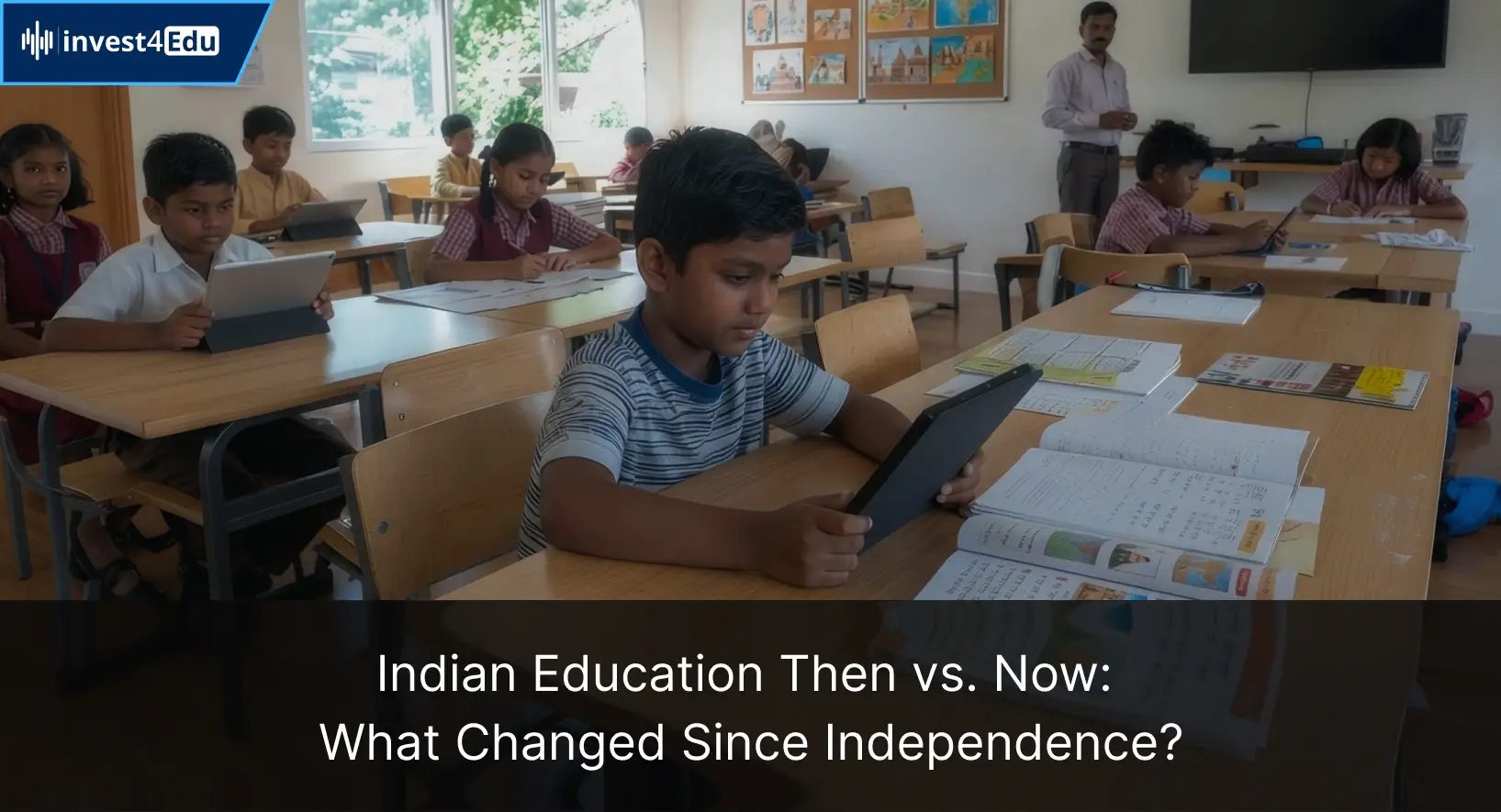
The classroom has also undergone many changes. Digital learning, smart boards, online learning platforms and even AI technologies have become a part of the education process, particularly during the lockdown period.
Indian Education System: Then vs. Now
Comparing the post-independence benchmark with modern-day statistics highlights the extent of the education revolution in India in almost eight decades.
Parameter | Early Post-Independence Period (1947–1951) | Modern Era (2025–2026) |
| Overall Literacy Rate | ~14% (1947) / 18.32% (1951 Census) | 81.1% (Periodic Labour Force Survey) |
| Female Literacy Rate | ~8% (1947) / 8.86% (1951 Census) | 70.3% Rural & 84.8% Urban |
| Status of Education in Law | Non-enforceable Directive Principles (Article 45) | Fundamental Right for ages (6-14 years) (Article 21A & RTE Act) |
| School Enrollment | Limited primarily to urban and elite pockets | Over 24.72 crore enrolments in schools across India (UDISE+) |
| Curriculum & Pedagogy | Rote memorization, strict exam structures, and rigid academic streams | Multidisciplinary, skill-integrated learning under NEP 2020 |
| Primary Challenge | Lack of physical schools and basic literacy | Outcomes & Employment of Graduates |
The Rise of the First-Generation Learner
The shift from the breaking of intergenerational barriers is one of the most crucial changes in the contemporary Indian education system. In the aftermath of the 86th Constitutional Amendment and Right to Education Act, elementary education was transformed from a social welfare objective to a statutory entitlement.
According to data collected by Oxford Poverty and Human Development Initiative, there are around 28 million Indian children who are the first generation in their family to get schooling for six years. Children of parents who never attended schools are going to schools and even universities across rural districts and tier-3 cities of India. The initiatives such as Samagra Shiksha and NIPUN Bharat have added another dimension to this objective of converting enrolment into literacy numeracy by Grade 2.
The Modern Paradox: Higher Degrees, Fewer Quality Jobs
While the issue of getting children into schools in India has been largely addressed, there is an enormous gap that persists on the other end of the education pipeline. Education stands out as the only way out of multidimensional poverty; however, labour market and World Bank reports reveal a concerning trend regarding graduates of Indian colleges having higher unemployment rates than those barely educated.
This paradox occurs due to two basic facts:
- The Skill-Market Mismatch: Traditional syllabuses focused for years on theoretical examination at the expense of problem-solving, resulting in inadequate preparation of many graduates to meet industry requirements.
- Inequality in Quality of Education: Where urban private institutions and benchmark schools implement AI technology, coding labs, and projects, many less equipped classes continue to face shortages of teachers, digital gaps, and learning deficiencies.
What Still Needs to Change
But the same study is a reminder that schooling alone is not enough.
- Poverty and education are very closely associated. Worldwide, among the 136 million school-age children who are not attending school, 110 million (over 80%) also suffer from multidimensional poverty.
- Education of the mother is important. Over two-thirds of the children suffering from multidimensional poverty belonged to households where no woman had completed six years of schooling.
- Children growing up in the same family have different fates. One may be at school while the other stays at home.
- Education does not necessarily lead to a good job. According to reporting based on recent data, education can help people rise above the level of poverty without necessarily ensuring a good job. Learning outcomes and job-related skills are what are missing.
- Nutrition, sanitation and housing all affect how well a child learns. An ill or hungry child cannot take full advantage of the class environment.
Looking Ahead: The Next Chapter Under NEP 2020
To address the gap between qualifications in the class and preparation for the career, the National Education Policy (NEP) 2020 is transforming the education system of Indian children. The shift from the traditional 10+2 education structure to a new 5+3+3+4 education system, inclusion of vocational training from Grade 6 onwards, and subject flexibility are gradually eliminating rote learning from the system.
Along with the creation of digital public infrastructure through PM e-VIDYA and adult literacy campaigns via ULLAS, the attention is now focused more on adaptability than accessibility.
Bridging the Gap: How invest4Edu Empowers India’s Young Students
As education shifts from classroom access to career readiness, families face two big challenges: choosing the right career path early and preparing for rising education costs. Without structured guidance, even college graduates often struggle to turn degrees into meaningful jobs.
invest4Edu, an education and financial planning platform, helps families replace last-minute guesswork with personalised academic roadmaps and goal-based financial planning.
Key Ways invest4Edu Supports Children and Parents :
- Know Your Child (KYC) Assessment: Instead of pushing children into conventional streams, invest4Edu’s KYC assessment gives parents clear insight into a child’s strengths and interests through a comprehensive psychometric test, backed by expert guidance, a personalised roadmap and counselling.
- Skill Building for Career Readiness: Degrees alone don’t guarantee jobs, so invest4Edu pairs career planning with skill-building programmes for school and college students. The aim is to help them build practical, job-relevant skills alongside their academics and close the gap between education and employment.
- Student Profile Building: Marks alone are no longer enough for top Indian and global universities. invest4Edu’s Profile Building Program helps students from Grade 8 onwards build a well-rounded profile through personalised planning, projects, certifications and expert guidance.
The Road Ahead- Building a Classroom Worthy of Today’s Children
India’s education story is no longer about whether children reach the school gate, but what happens once they step inside. Will they read with understanding, think freely, and find dignified livelihoods? The 28 million pioneer children show what is possible when policy, community and family aspiration align. Our task now is to make them the first of many to turn education into a lasting career opportunity. This Children’s Day, the finest tribute to Chacha Nehru’s vision is a commitment that every child, in every village and city, gets a real chance to learn, grow and thrive.
Happy Children’s Day!!!