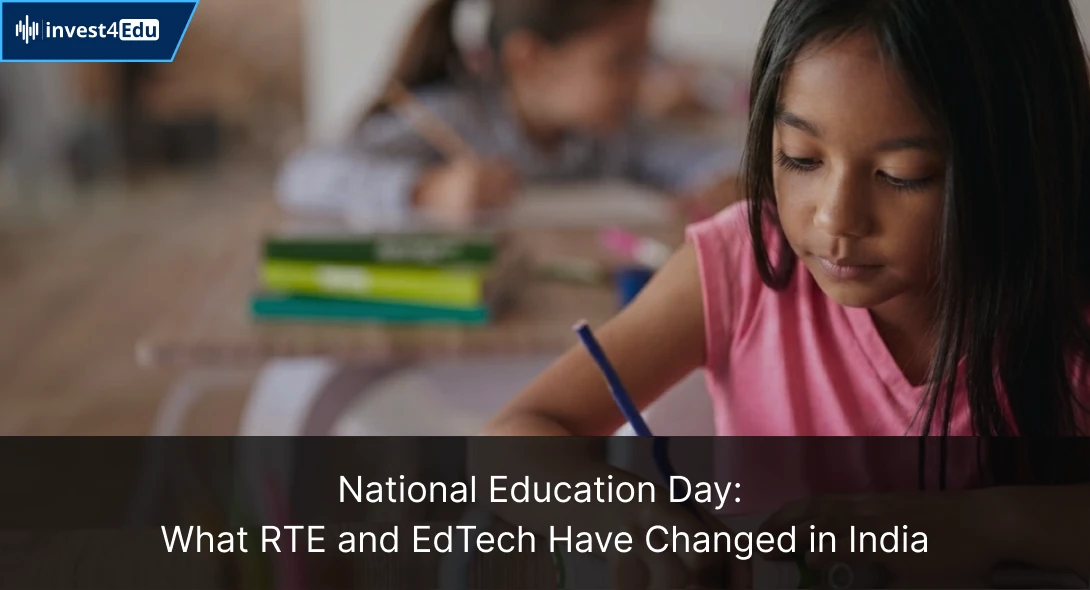





National Education Day: What RTE and EdTech Have Changed in India
In honor of the birth of Maulana Abul Kalam Azad, who was the first Education Minister of India, India celebrates National Education Day every year on November 11. Education was considered by him as the foundation for social equality and development of the nation. In today’s India, the educational system has taken a technological turn.
However, this development leads to a crucial question – what are the major developments that are revolutionising the way India educates? It could all be summed up through two very crucial developments – one is through the RTE Act through which education has become a legal entitlement for all children between 6 and 14 years of age, and the other through the advent of EdTech through which classrooms are brought straight to phones and laptops.
What Is National Education Day?
India celebrates National Education Day every year on November 11. It is the day that the Ministry of Education (earlier referred to as the Ministry of Human Resource Development) designated 11th November as "National Education Day" on 11th September, 2008.
Celebrated every year since 2008 as a tribute to the birth anniversary of Shri Maulana Abul Kalam Azad in memory of his tremendous contribution to the field of education in India, it is not a holiday but an occasion when educational institutions celebrate this day through literacy drives, seminars and workshops.
At a time when 65% of the country's population is below 35 years of age, quality education becomes very important in ensuring the socio-economic progress of India.
Who Was Maulana Abul Kalam Azad?
Maulana Abul Kalam Azad (11 November 1888 – 22 February 1958) was a freedom fighter, scholar, journalist, and poet. He worked as the first Education Minister of independent India from 1947 to 1958 and was conferred with the Bharat Ratna after his death in 1992. Azad had understood that literacy and scientific temper were crucial in building a nation. Even before any statutory requirement came into being, Azad had recommended free basic education till 14 years of age and emphasized women’s literacy.
Major Contirbutions by Moulana Azad :
Formation of Higher Educational Institutions: He was instrumental in setting up India’s most prestigious technical institution, IIT Kharagpur, in 1951 and initiating the University Grants Commission (UGC) in 1953.
Cultivation of Culture and Arts: During his tenure, important national institutions such as Sahitya Akademi, Sangeet Natak Akademi, and Lalit Kala Akademi were set up.
Development of Research Facilities: He was one of the principal architects behind the establishment of research organizations and development of technical education, as well as teaching in native tongues at the primary level.
To explore official legislative archives and national education policies, visit the Ministry of Education portal.
Post-Independence Education Timeline
Year / Period | Key Educational Development |
1947–1958 | Maulana Abul Kalam Azad lays the foundation for India's higher education system. |
1951 | Establishment of IIT Kharagpur, India's first Indian Institute of Technology (IIT). |
1953 | Inauguration of the University Grants Commission (UGC). |
2008 | Ministry of Education declares November 11 as National Education Day. |
2009 | Passage of the Right of Children to Free and Compulsory Education Act (RTE Act). |
2020s | Digital transformation of education accelerates, with EdTech companies expanding access to learning across India. |
Universal education was recommended by Azad as far back as the 1940s, but it was not until 2009 that the Parliament made universal education an enforceable right. This occurred through the enactment of the Right to Education Act (RTE), which made universal education a right for all children.
What Is the Right to Education Act?
The Right to Education (RTE) Act is the common name for the Right of Children to Free and Compulsory Education Act, 2009. It was enacted on 4 August 2009 and came into force on 1 April 2010. It follows the 86th Constitutional Amendment (2002), which inserted Article 21A and made education a fundamental right for children aged 6 to 14.
In plain terms, the Right to Education means:
Children between the ages of 6-14 are entitled to go to their neighbourhood school for free education up to class VIII.
A primary school will be available within 1 km and an upper primary school within 3 km radius of a child’s residence (as mentioned in norms of the Act; do refer to your respective State Norms).
As per Section 12(1)(c), it is mandatory for private unaided non-minority schools to reserve a minimum of 25 percent of seats for economically weaker children and other disadvantaged communities at entry level.
The school must comply with all norms regarding pupil teacher ratio, classrooms, drinking water and toilets, and should not conduct any screening test or charge capitation fee.
Refer to the official website for further details: Department of School Education and Literacy and the Government of India's India Code portal.
What Has the Right to Education Changed?
Through legalising school attendance, the Right to Education Act has brought about a sea change in physical accessibility to schools in India:
Surge in Primary Enrolment: Net primary school enrolment exceeded 95% consistently, and brought millions of children outside school system into formal classroom settings.
Compulsory EWS Reservation: Non-aided private schools are legally required to have a 25% reservation for admission at entry level for children from Economically Weaker Sections (EWS) and other socially backward communities.
Quality Infrastructure: The Act has set quality standards including Pupil Teacher Ratio (PTR), potable water supply, playground and separate toilets for boys and girls.
Child-Centric Environment: It strictly prohibits corporal punishment, mental torture, capitation fees, interviews on admission and detention of children in the same class throughout elementary years.
For constitutional rights in legislative forms, you can consult Legislative Department, Ministry of Law and Justice.
How Has EdTech Changed Learning in India?
Whereas the Right to Education (RTE) Act managed to enroll millions of kids in actual classroom settings, EdTech businesses from India made another stride by taking the concept of education to a level beyond the traditional classroom.
Edtech or education technology is basically the use of technological devices including applications, video classes, and online courses and even artificial intelligence-enabled tutors to learn. The Indian edtech industry has witnessed rapid growth in the last decade, especially when the COVID-19 pandemic caused shutdowns in schools. Invest India, which is the national agency responsible for investing in the country, sees it as an industry that has revolutionized learning and still has a lot of potential left.
Here is what changed on the ground:
Learning moved beyond the classroom
The student in the rural area can now view lectures from a teacher in another city, revise the subject at 11 p.m., or take mock tests unlimitedly. All these could not be possible without smartphones and data that is affordable.
The government built public EdTech too
Not all the EdTech is private, there are national platforms that include :
DIKSHA, a national digital platform for school education which provides textbooks and learning materials based on state and national curriculum.
SWAYAM, provides free online courses from India.
PM eVidya, launched in 2020 which brings digital learning content through TV, radio, and online mediums.
National Education Policy 2020 approved on 29 July 2020 supports using technology in teaching, evaluation and teachers' training.
EdTech companies in India
The early stage of growth focused mainly on K-12 education and test preparation applications. Today, however, in India, EdTech startups cover skilling and upskilling, school management systems, language learning, and career counselling. estimated at about $7.5 billion.
India is the second largest market for EdTech services in the world, with the forecast showing that it will grow to $33.3 billion in the coming decade. Thanks to the large base of students (250+ million) and internet users (more than 950 million), many startups start focusing on learning results rather than user growth numbers.
To deliver these educational advancements, modern digital platforms leverage several key capabilities:
Hyper Personalised Learning: AI-based platforms offer personalised practice modules based on an individual student's learning pace in subjects like STEM.
Competitive Exam Prep for All: Aspirants belonging to Tier-2, Tier-3, and rural locations can now avail themselves of top-quality entrance coaching (JEE, NEET, UPSC) courses at a small portion of the offline coaching fees without having to move to urban areas.
Visual Interactive Learning: Scientific and mathematical concepts are taught using visual 3D models and interactive modules.
Where Are The Gaps That Need To Be Filled?
Honest evaluation of existing problems is an integral part of celebrating the day.
Quality of learning: There is high enrolment, but there remain gaps regarding reading and mathematics literacy among children in certain regions.
The gap in the digital space:It affects those who have devices, access to Internet, and self-study habits.
Costs and confidence: Not all EdTech tools will be helpful in education, which is why you need to check the results, refund policies, and qualifications of teachers before signing up.
Regulation: It is currently implemented in a form of self-regulation in case of advertisements of EdTech.
How Can Students and Parents Utilize This Opportunity?
As an EdFinTech and career guidance platform, invest4edu helps students and parents build a clear roadmap for academic and financial success. Our Know Your Child (KYC) framework uses expert guidance and psychometric testing to discover a student's unique strengths, interests, and learning style. This makes it easy for families to pick the right courses, streams, and entrance exams with complete confidence. Plus, by combining smart career guidance with early financial planning, parents plan their finances early so rising tuition fees never stand in the way of their child’s dreams.
Conclusion
National Education Day brings back memories of Maulana Abul Kalam Azad's vision of education for all which has gone from concept to legislation to reality. The Right to Education Act gave entrance into schools, while EdTech has broadened the classrooms beyond the schools. What remains to be done is ensuring that all children enrolled in schools are learning by providing fair admissions and equal access to technology.