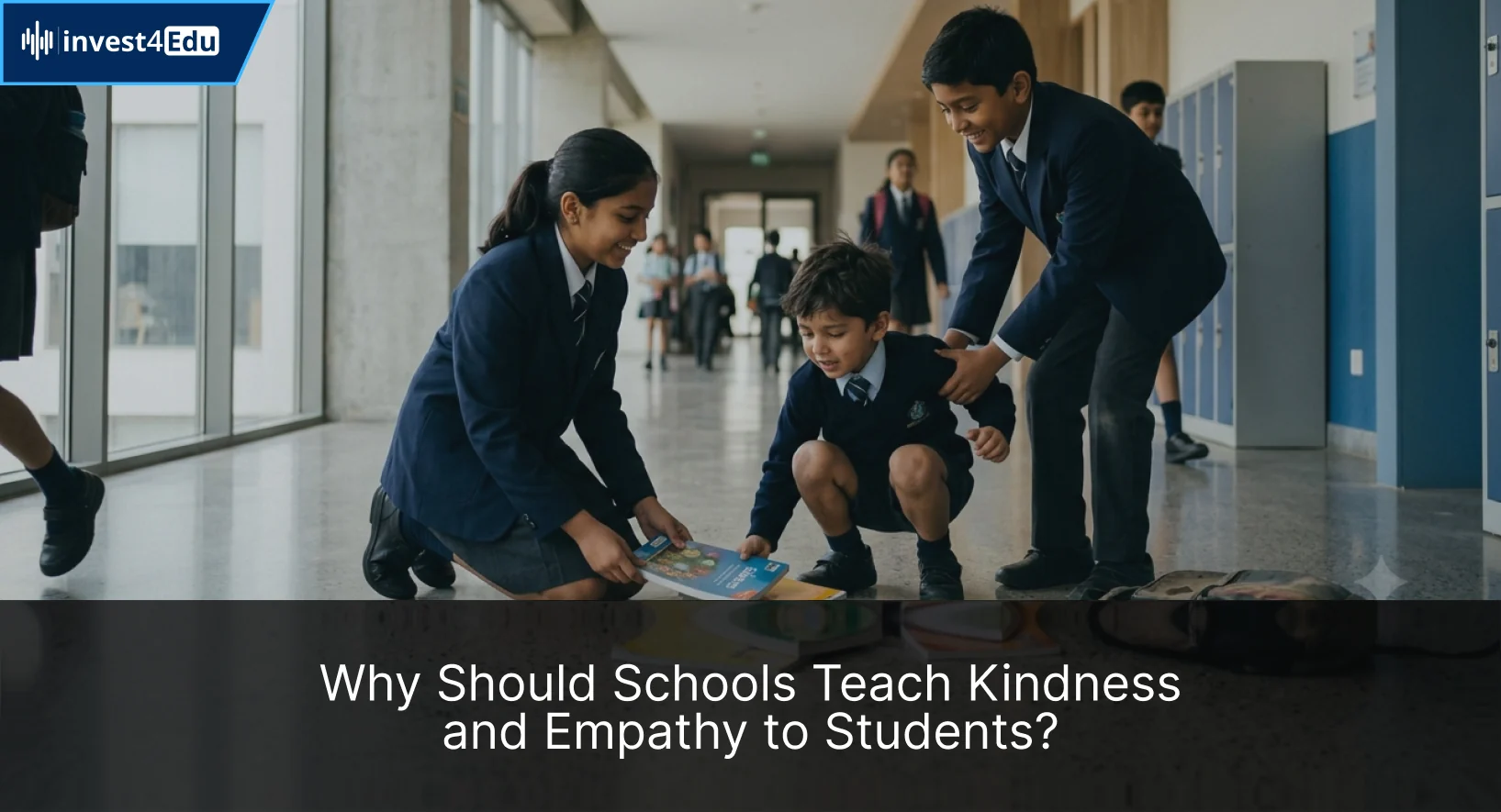





Why Should Schools Teach Kindness and Empathy to Students?
Over the past year, a few incidents involving Indian schoolchildren have left many parents shaken. In August 2026, two Class 10 students in Telangana were detained in connection with the murder of their school principal. In Rajasthan, a nine-year-old girl died at her school in November 2025. A CBSE inquiry later found that her parents’ repeated complaints about bullying had gone unanswered. And in October 2026, an eight-year-old boy allegedly attacked a six-year-old girl at a school in Haryana, leaving her seriously injured.
As a parent, it’s hard to read news like this. It also leaves us with some uncomfortable questions. Do children know what to do with their anger? Do they understand how their actions hurt others? When they see someone being bullied, do they know how to help?
World Kindness Day, observed every year on 13 November, is a good moment to think about this. Kindness and empathy go beyond being a good friend or behaving well at home. What children learn now, they carry into their communities and, one day, into adult life.
Of course, kindness lessons alone can’t stop bullying or violence. Schools also need proper supervision, counselling and clear safety rules. But teaching children to understand others’ feelings, respect differences and handle disagreements matters too. In this article, we look at why these values matter in schools and in society, and what teachers and parents can do to build them.
What Are Kindness and Empathy?
Kindness is what you do when you care about someone. With children, it's usually small stuff. Lending a pencil. Helping a friend who's stuck on a sum. Saying thanks to the bus driver.
Empathy comes a step earlier. A child is showing empathy when they look at a classmate's face and can tell something's off, or when they try to imagine how they'd feel in that classmate's place.
People mix the two up all the time, which is understandable. One way to explain it to a younger child is that empathy happens inside your head, when you realise your friend is upset, while kindness is the part everyone can see, when you walk over and ask if they're okay. A few school examples make it clearer:
School situation | Empathy (understanding) | Kindness (action) |
A student is sitting alone | They may be feeling left out | Invite them to join the group |
A classmate gives a wrong answer | They might feel embarrassed | Don't laugh or make hurtful comments |
A new student joins the class | They may feel nervous in an unfamiliar place | Offer to show them around |
Two friends are arguing | Each may see what happened differently | Listen before taking sides |
Someone is being bullied | They're probably scared or hurt | Tell a teacher or a parent about it |
You can spot bits of both even in toddlers. But school is where children really get to practise, because they're with the same thirty classmates every single day.
Why Does This Matter So Much at School?
Ask your child about their day. Do they talk about fractions? Hardly ever. You'll hear who wasn't talking to them, who laughed when they got an answer wrong, who saved them a seat. Most of that is about kindness. Or the lack of it. Here's why they're worth taking seriously.
1. Friendships Last Longer
Kids' friendships can be dramatic. Best friends on Monday. Not speaking by Wednesday. The reason? A cricket match. Or the window seat on the bus.
Empathy is what makes a child think, "Hmm, maybe he's upset too." Kindness is what stops them from saying the nasty thing that's on the tip of their tongue.
Sports day. One kid comes last in the race and is trying very hard not to cry. A few classmates might laugh. Others might go up and say, "You ran really well." Over time, it's usually that second group of kids who end up with friendships that last.
2. Classrooms Feel Safer for Everyone
Bullying isn't always physical. It can be repeated teasing. Or being left out of every group, on purpose. Or mean messages in the class WhatsApp group. Yes, that's bullying too.
A child who’s been teased remembers how it felt, and usually thinks twice before doing it to someone else. They're also quicker to notice when a friend has suddenly gone quiet. Schools can encourage students to:
avoid jokes about someone's looks, abilities or family background
make room for classmates who usually get left out
keep arguments respectful
speak to a teacher, or another adult they trust, when someone is being picked on
So does kindness alone stop bullying? No. Schools also need proper rules, teachers on duty in the corridors and playground during break, and an easy way for kids to report what's going on.
3. More Hands Go Up in Class
If a child thinks the class will laugh, they won't ask. They'll just sit there, confused, and hope the teacher moves on.
Kids will get answers wrong. They'll forget homework. They'll ask the teacher to explain the same thing again. Totally normal. When nobody laughs at a wrong answer, more kids are willing to put a hand up and try.
4. Group Projects Go Better
In a group project, you rarely get to work with people who think exactly like you.
Empathy matters here. It makes a child actually hear what a groupmate is suggesting, rather than just waiting for their turn to speak. Kindness means they can still disagree, without making anyone feel stupid.
Let's say one boy in a science project group can't finish his part. The others could complain. Or they could ask what's wrong and share out the remaining work. That's teamwork.
5. Different Kids Get Along Better
Look around any class. The kids come from all kinds of homes, speak different languages and like different things.
Some kids have a best friend by lunchtime on day one. Others take months. The maths topper might be struggling with Hindi.
Once kids realise that everyone finds something hard, they're usually gentler with each other.
The idea isn't to make everyone alike. It's about getting along with kids who aren't alike.
6. Bad Days Get Easier to Handle
School comes with plenty of ups and downs. Winning the inter-house quiz feels amazing. Getting a bad report card feels awful.
A child who understands feelings, both their own and other people's, copes better with both. They're less likely to show off their marks to a friend who did badly, and more likely to just sit with them for a bit, which is often all that friend wants.
Do that often enough and it becomes a habit, one they'll still have as grown-ups.
Why Is Teaching Kindness and Empathy to Children Important for Society?
What a child learns about respect doesn’t stay there. It grows up with them. How a child treats a classmate today often shapes how they’ll treat a neighbour, a colleague or a stranger years later.
Think of a few ordinary moments. Someone is being trolled online. An elderly man is struggling to find a seat on a crowded bus. Two people are arguing because they see the same thing very differently. Empathy is what makes a person pause and ask, “What might they be going through?”
This matters even more in India. Our neighbours speak different languages, follow different faiths and grow up with different customs. Nobody expects all of us to think the same way. But children can learn to listen, to respect what’s different and to disagree without being rude.
Of course, empathy alone won’t fix society’s problems. We still need fair laws, accountability and people who speak up when something is wrong. Even so, a lot depends on how ordinary people treat each other when nobody is watching.
Teaching empathy isn’t just about raising well-behaved kids. It’s about building a better society.
Does Indian Education Policy Back This Up?
Is this just a "nice to have"? Not according to India's education policies.
NEP 2020: For the National Education Policy, a good school isn't one that only produces toppers. It wants children to turn into good people, and words like compassion, empathy, courage and resilience appear in it.
NCF-SE 2023: Empathy, inclusion and respect for diversity are all in the National Curriculum Framework for School Education, on its list of values schools should build. It also wants schools to be warmer, more inclusive places.
CBSE: Its circular of 20 February 2026 is very practical. Every affiliated school has to train all its staff, from teachers to office and support staff, in mental health support at least twice a year. The idea is that someone notices when a child is struggling and knows what to do next. Schools are also asked to bring social and emotional learning into regular lessons.
In other words, the people setting education policy agree that marks aren't everything. Feelings and friendships count too.
How Do Other Countries Teach Kindness and Empathy?
In many countries, kindness and empathy aren't treated as lessons to be taught once and forgotten. They're part of everyday school life.
Japan: In many Japanese schools, children help clean their classrooms and shared spaces. They also take turns serving school lunches. These routines teach children to take responsibility for their surroundings, work together and respect shared spaces.
Finland: Student well-being is an important part of the education system. Schools are expected to create an environment where children feel safe, included and supported. Teachers also pay attention to students' individual needs and encourage them to participate in school life.
Denmark: Schools encourage children to take responsibility and participate in democratic school life. Students have opportunities to express their opinions, including through classroom discussions and student councils. This helps them learn that their views matter while respecting the rights and views of others.
Sweden: Respect for others and equality are part of the national school curriculum. Schools are expected to help children understand different perspectives, show empathy and stand against discrimination and bullying.
China: Moral education is an important part of schooling. Alongside academic subjects, schools are expected to develop students' discipline, responsible behaviour and respect for others. Social activities and community service also give students opportunities to develop a sense of responsibility towards society.
What do these countries have in common? They don't leave values education to textbooks alone. School routines, classroom activities and everyday interactions also give children opportunities to practise what they learn.
This is especially relevant in India, where a single classroom may have children who speak different languages, follow different religions and come from different backgrounds. Empathy helps children understand those differences, while kindness helps them treat one another with respect.
These lessons don't end at the school gate. They influence how children interact with others as they grow up and become part of the wider community.
Where Do Teachers Begin?
Teachers don't need a new period for this, which is a relief given how full timetables already are. It slips into regular lessons, school events and the gaps between classes.
Kids watch the teacher. Little things don't escape them. Who always gets asked to answer? Who keeps getting cut off? When a teacher says "My mistake" in front of everyone, or gives the back-bencher the same patience as the topper, that sticks with kids far longer than any lecture.
Use stories. Pick a Panchatantra tale, a chapter from the English reader or even a cartoon they all know. Halfway through, ask, "Why did he do that?" or "How do you think she felt?" Hands will shoot up. And without realising it, they're putting themselves in someone else's shoes.
Group work means compromise. Somebody's idea gets dropped. Somebody doesn't do their share. Working through that is how kids learn they can't always have things their way.
Arguments can be learning moments. Two boys fighting over a cricket bat? The teacher could simply punish both of them. Another way is to let each boy tell his side and then ask, "How do you think he's feeling right now?" Quite often, they patch things up on their own. Bullying is a different thing altogether, though. That needs firmer action.
Include every child. The new kid who's just moved from another place. A boy with dyslexia. A girl who speaks Telugu at home and still gets nervous speaking English in class. None of them should feel like a guest in their own classroom.
Why One Kindness Week Isn't Enough
A special assembly or a poster competition is a nice start. But children learn far more from ordinary school days: who helped them on a random day, and who didn't.
Kids need to know what's expected. The anti-bullying rules apply to the class topper too. And if a child comes to a teacher with a problem, it deserves more than a quick "Okay, go and sit down." Get those right, and kindness stops being a value education chapter. After that, it's simply the way things are done there.
A Few Activities to Try
Lectures on kindness only go so far. Kids get it when they do it. None of these need a budget.
Activity | How it works | What students learn |
Kindness Box | Students drop in notes about kind acts they've noticed. The teacher picks a few to discuss, without naming anyone unnecessarily | Noticing and appreciating kind behaviour |
Role-play | Students act out a scene where a child is left out, then discuss what the others could have done | Imagining how others feel |
Story discussions | After a story, the class talks about how each character might have felt | Recognising emotions |
Buddy system | An existing student helps a newcomer learn the school and its routines | Cooperation and inclusion |
Thank-you notes | Kids write a short thank-you to someone, maybe a friend, the school guard or their Nani | Gratitude |
The real goal is for this to carry over to the playground and the lunch queue. A quick reminder from the teacher every now and then helps.
What About Parents?
A school can't do this alone. A lot of what children learn about kindness, they pick up at home, just by watching you.
Kids copy you. They see how you talk to the delivery person, the security guard and your own parents. If you stay polite even when you're annoyed, they learn that kindness doesn't switch off when someone is upset.
Let them finish. Your child comes home upset. Before the advice starts, hear the whole story. Then ask how they felt. And how the other kids might have felt.
Hand over small jobs. Setting the table. Fetching Dadi's glasses. Tiny things, but they get a child thinking about someone other than themselves.
Praise the small stuff. Your son shared his snack with a friend? Your daughter was patient with her little brother? Tell them you noticed. Kids light up when a parent notices them being good.
Help them through fights. Siblings fight. Over the TV remote, the last samosa, whose turn it is. Each child gets a turn to talk. The other has to actually listen, no interrupting. Then help them settle on something both can live with.
Do Kind Kids Have to Say Yes to Everything?
No. And children should hear that clearly.
A kind child doesn't have to agree with everyone, lend out their things or put up with someone who makes them uncomfortable.
They can say no politely. They can disagree with a friend. They can go to a teacher when someone is bothering them. None of that is unkind.
If a classmate keeps asking to copy their homework, it's fine to say, "No, but I'll explain it to you." That's actually more helpful.
And no child should ever be told to put up with bullying just to be "nice".
Being kind also means looking after themselves. Children should feel free to say no to what makes them uncomfortable, speak up when something feels wrong, and ask an adult for help.
How Can Teachers Tell If Students Are Learning These Values?
Empathy can’t be tested on paper. A few things worth watching for teachers:
Do students make room for others in group work?
Can they disagree without getting personal?
Do they listen when a classmate is talking?
Do they help when someone's struggling, without being asked?
Do they notice, and say sorry, when they've upset someone?
A teacher who watches for these signs will soon know which children need a little extra guidance. But kids have off days. So look at the whole year, not one bad week.
Conclusion
There’s no column for kindness on a report card. It grows with the support of home and school.
When you’re choosing a school, results are worth looking at. Alongside that, it’s fair to ask the school a few things too, like how they respond when a child is bullied. Who helps a student who’s struggling? What do they do to help kids get along?
No two children are the same. Knowing your child’s strengths, personality and behaviour matters just as much as their marks. Invest4Edu’s Know Your Child (KYC) Plan combines a psychometric assessment with guidance from our experts to help you understand your child better, so planning their education feels far less like guesswork.