




Students usually make education decisions one at a time. First comes the stream, then the course, the college, and eventually the job. What isn’t always obvious is how much these choices affect what comes later.
Once students look more closely at a career, they often find there is more to it than the degree itself. There may be another exam, some hands-on experience to gain, or further study they had not considered at the start. The cost of those extra steps changes the plan too.
Students usually start thinking seriously about money only after they begin working. Financial independence grows from there, even though some of the groundwork was laid much earlier through education and career choices.
This Independence Day, that is the freedom worth looking at—the freedom to choose an education path with more clarity today and build towards an independent future tomorrow.
What Does Financial Independence Mean for a Student?
For a student, financial independence usually comes in stages. The first salary may cover only a few personal expenses at the beginning. As their income becomes more stable, they slowly take on more responsibility for their own needs.
There is also the question of what they do with the money they earn. Paying regular expenses, keeping something aside, and planning for future needs all become part of managing life on their own.
So, financial independence is not just about getting a job. It is about reaching a point where students can earn, manage their money, and rely less on others for everyday financial needs.
The Path to Financial Independence Starts Before the First Salary
Students may not start earning until after college, but preparation for a career begins much earlier. The course they choose, the skills they pick up, and experiences such as projects or internships all influence how ready they are when they begin looking for work.
It helps to know where a course may lead. In some careers, a degree is enough to get started. Others require practical experience, a specific skill, or another qualification. Students who are still unsure about what suits them can use career guidance to explore a few possible paths before deciding what comes next.
Career ideas can change during school or college, and that is normal. A subject that seems interesting today may lead somewhere unexpected later. Having some direction gives students more time to understand their options before graduation.
Financial independence is often still years away at this stage. What education planning does is prepare students for the career and earning opportunities that eventually help them move towards it.
Education Decisions That Can Shape Financial Independence
Education planning becomes more useful when students know what they are working towards. They do not need every part of their career figured out, but it helps to understand what a course can lead to and what may come after it.
Connect the Course to the Career
A course name tells only part of the story. Students can also look at the kind of work graduates move into, whether that work suits them, and what may be required before they can enter the profession.
For some careers, the degree may be enough to get started. Others involve entrance tests, professional exams, further study, licensing, or training. Looking at the complete route gives students a better idea of the time and effort involved before they commit to a course.
Salary can be part of that research, but it should not become the only deciding factor. Interest, career scope, the nature of the work, and the overall education journey matter too. Students who want to compare these factors further can look at career pathways and course ROI.
Build Skills Alongside the Degree
What students learn in class may not cover everything they later need at work. Depending on the field, internships, communication skills, technical tools, projects, certifications, or some hands-on experience may become important.
College gives students time to work on these areas before they begin applying for jobs. The exact mix will be different for every career, but gaining practical exposure can help students understand the work better and improve their employability.
Invest4Edu's guide on preparing students for future careers looks more closely at the skills students may need as they move towards work. The need to keep learning is likely to remain important too. The World Economic Forum’s Future of Jobs Report 2025 says employers expect 39% of workers’ core skills to change by 2030.
Leave Some Room for Change
A plan made at 16 or 17 may look different by the time a student reaches college. An internship can reshape their view of a profession, and a subject that looked ordinary at first may turn out to be the part they enjoy most.
Changing direction does not always mean the earlier choice was wasted. Sometimes it simply means the student now has better information. What matters is understanding what the new path involves before making the next decision.
Education planning, therefore, does not have to lock students into one career. It can give them enough direction to make informed choices while still leaving room to adjust as they learn more about themselves and the working world.
What Does the Right Education Plan Give Students the Freedom to Do?
A good education plan does not promise that every decision will work perfectly. It gives students more room to make choices with some understanding of where those choices may lead.
Freedom to Choose
Students often begin with a long list of possibilities. A few disappear once they learn what the course actually involves. Others may become more interesting after they understand the career behind them.
That kind of exploration matters. It gives students a chance to see what suits them before they commit several years to a course.
Freedom to Prepare
Once a student has some idea of the career they may want, preparation becomes more specific. They can find out whether the field needs an entrance exam, an internship, a certain technical skill, higher education, or something else beyond the degree.
There is also more time to work on these things. Instead of reaching the final year of college and discovering a gap, students can start filling it while they are still studying.
Freedom to Access the Right Opportunities
Sometimes a student finds the right course or college, but the cost becomes the difficult part. This is where education planning has to include more than academics.
Looking at the cost early can open up more options. There may be scholarships to apply for, savings already available, or a loan that covers part of the expense. Families then have time to work out what they can manage instead of dealing with the entire cost only when admission arrives.
Freedom to Build an Independent Future
The effect of all these choices isn’t always visible while a student is still in school or college. It shows up later, when they start looking for work and using what they have learnt.
A student who reaches that stage with relevant knowledge, useful skills, and some understanding of the career they are entering has a better starting point. From there, earning begins, and students can gradually start handling personal expenses and taking on more financial responsibility.
Financial independence may come much later, but the freedom to work towards it begins with the education choices made years earlier.
Education Planning Also Has a Financial Side
A student may find the right course and college, but the decision still has to work financially. College fees are only one part of the expense. Hostel charges, travel, entrance tests, books, coaching, or further qualifications may also add to the cost.
This matters even more when a student plans to study away from home or when the education path takes several years. In higher education planning, looking at the full cost early gives families a clearer idea of what they already have and what may still need to be arranged.
Scholarships can reduce part of the expense for some students. Families may also use savings, an education loan, or a mix of different options. Invest4Edu’s guide on education loan vs scholarship vs self-funding explains how these choices differ and where each one may fit.
The financial side should not decide the career on its own, but it should not be left until the admission letter arrives either. Planning the cost early can help families support a suitable education choice without having to rethink it at the last moment.
When Should Education and Career Planning Begin?
Career ideas usually take shape over time. A student may be interested in one subject now and find something completely different a few years later. There is no need to settle on one career too early.
Before Class 10
Students at this stage do not need a fixed career answer. What helps more is paying attention to the things they return to on their own. Those small patterns can become useful later when education and career planning get more serious.
Around Class 10
The choices become more specific here because stream and subject selection affect which courses remain open later. Students who are unsure can look at the subjects involved and the careers connected to each option. Invest4Edu’s guide on choosing the right stream after Class 10th looks at this decision in more detail.
In Classes 11 and 12
By this stage, students can start checking course requirements, entrance exams, colleges, and what comes after the degree. It is also a useful time to find out whether the career they have in mind needs higher studies or any additional qualification.
During College
Education planning does not stop once admission is done. College is often when students see what a profession looks like outside textbooks. An internship can help them understand whether the actual work matches what they had imagined.
A plan made in school does not have to remain unchanged through college. New information can shift it along the way. For a fuller year-by-year view, Invest4Edu’s education journey timeline maps the path from nursery through postgraduation.
Financial Literacy Comes Next
Getting into a career gives a student the chance to start earning. What happens with that money is a different part of the story. A first salary brings expenses with it too, and students begin finding out how far their income actually goes.
This is where basic financial literacy for students becomes useful. Knowing what is being spent each month, keeping some money aside, and understanding borrowing can help when students begin handling their finances on their own. Invest4Edu’s existing guide covers these money-management basics in more detail.
For students, financial freedom is not only about reaching a stage where they can earn. It also depends on what they are able to do with that income once it starts coming in. Education and career planning help with the first part of that journey; learning to handle money becomes important after that.
From Education Plan to Financial Independence
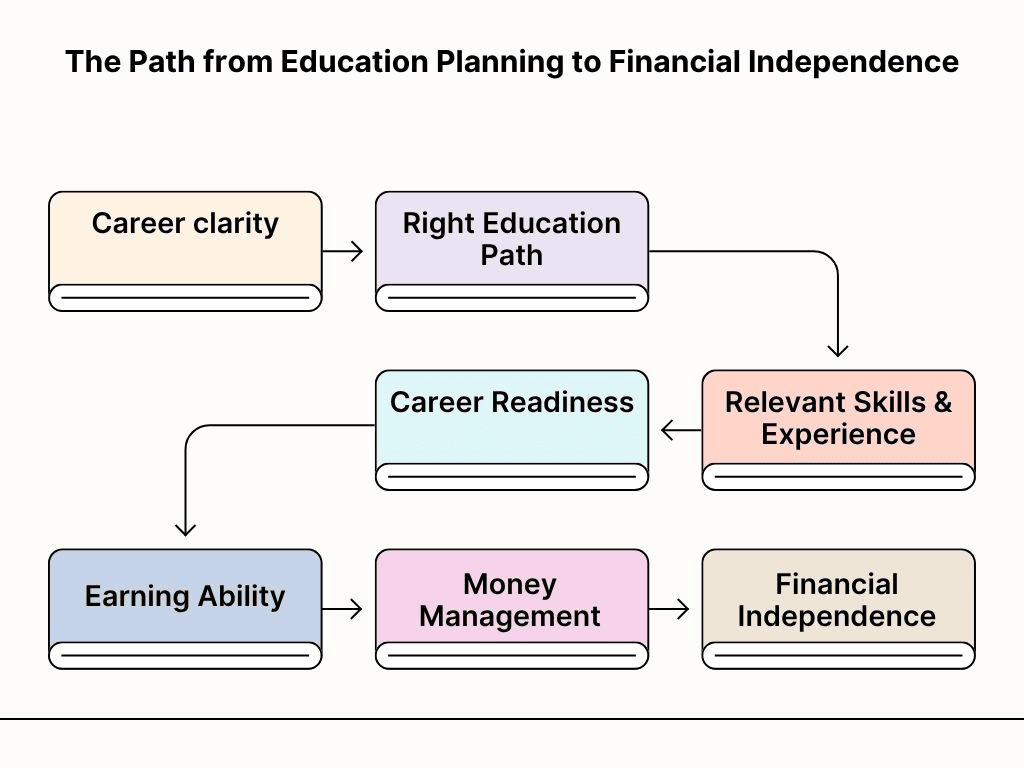
The connection becomes easier to see after these choices start coming together. A course can lead to certain skills, those skills can open up career options, and work eventually brings income and a new set of financial responsibilities.
That is how education planning becomes part of financial independence, even though the two may seem far apart when a student is still in school.
How Parents Can Help Without Making the Decision for Their Child
Big education decisions are rarely made by the student alone. Parents may help compare colleges, understand costs, or look more closely at what a course or career involves.
They may also notice strengths the student has not considered yet. Where the choice is still unclear, career guidance can bring another point of view into the discussion.
The aim is to support the student without taking over the decision. Their interests, abilities, and comfort with the chosen path should still have a place in the final choice.
How Invest4Edu Helps Build the Complete Education Plan
Choosing a career is only one part of the journey. Students may also need help understanding their strengths, comparing courses and career paths, planning the education journey, and knowing what that path may cost.
Invest4Edu’s Know Your Child (KYC) Plan brings these pieces together through psychometric assessment, expert counselling, a personalised education roadmap, and financial planning. It gives students and parents a way to look at academic, career, and financial decisions as parts of the same journey.
This can be useful when several options seem possible or when the family wants more clarity before making a major education decision. The aim is to understand what suits the student and build a plan around where they want to go.
That makes KYC particularly relevant to the idea behind this article: the path towards financial independence can begin with better-informed education and career choices.