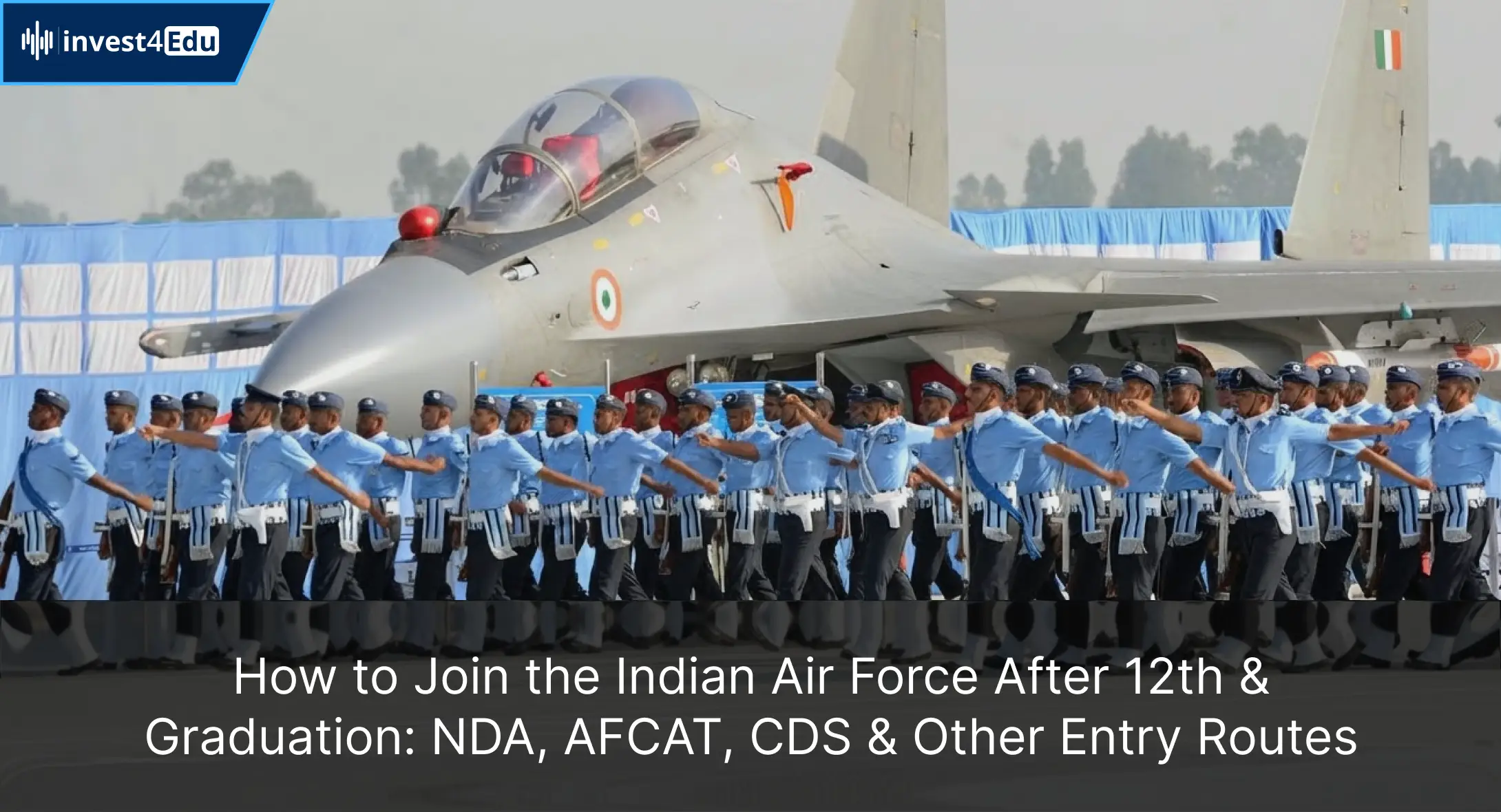





How to Join the Indian Air Force: 9 Entry Routes After 10th, 12th & Graduation
Ask most teenagers what an Air Force career looks like, and they'll describe a fighter cockpit. But the Flying Branch is just one of the IAF's three officer branches. Others join as engineers, administrators or meteorologists, and many more come in through the Agniveervayu scheme.
So the first question isn't how to become a pilot. It's whether you want to join as an officer or as an Agniveervayu. If flying is the goal, only officers become pilots.
With the IAF's 94th Air Force Day falling on 8 October, here are the routes in, grouped by qualification: after Class 10, after Class 12 and after graduation. The eligibility and entry details are based on the 2026 notifications, but age limits and vacancies can change every cycle, so always check the current notice.
Officer or Agniveervayu? Decide This First
| Officer | Agniveervayu |
What you do | Lead teams; fly, or head technical and administrative units | Work as a skilled technician or in support roles |
Rank | Starts as Flying Officer, a Group 'A' gazetted post | A distinct Agniveervayu rank under the Agnipath scheme |
Minimum education | Class 12 (NDA) or graduation (other routes) | Class 10 for the Musician and Non-Combatant streams; Class 12 or a diploma for the main Agniveervayu entry |
Selection | Written exam (or exemption) → | Online test → fitness and adaptability tests → medical |
Service | Permanent, or a fixed Short Service Commission of 10–14 years | 4 years, with a chance to join the regular cadre |
Starting pay | ₹56,100 basic + ₹15,500 Military Service Pay + allowances | ₹30,000 a month in year one, rising to ₹40,000 in year four |
If you'd rather start serving soon after school, Agniveervayu is the main way to do that. Many students apply for it alongside NDA.
Officers serve in one of three branches: Flying, Ground Duty (Technical) and Ground Duty (Non-Technical). We explain each one after the routes below.
Routes by Qualification at a Glance
Find your row, then jump to that section below.
Your qualification | Routes to check | Officer or not? |
After Class 10 | Agniveervayu (Musician), Agniveervayu (Non-Combatant) | Not an officer |
After Class 12 | NDA, Agniveervayu, Group Y Medical Assistant | NDA: officer. Others: not an officer |
After graduation | AFCAT, CDS, NCC Special Entry | Officer |
After engineering | AFCAT Technical, GATE Score Entry | Officer |
Options After Class 10
Most IAF entries need at least Class 12, but two smaller Agniveervayu streams take Class 10 candidates. Both are announced on the IAF recruitment portal, so check it regularly.
1. Agniveervayu (Musician)
This one's for students who are serious about music. You'll need Class 10 with at least pass marks, real skill on an instrument from the IAF's approved list, and proof of it, such as a Grade 5 certificate or a music diploma. Unmarried men and women can apply. Each intake sets its own age window, so check it in the notice.
You register online, then attend a recruitment rally. There, you go through document checks, fitness tests, an English test and a music test, followed by a medical. If you're selected, you join for the four-year Agnipath engagement as an Agniveervayu musician.
2. Agniveervayu (Non-Combatant)
This entry takes unmarried men with Class 10 for hospitality and housekeeping roles at Air Force stations, from cooking and serving in messes to cleaning and upkeep of buildings. Here too, the age window is set in each intake's notice. Applications go by post, or into a drop box at a listed Air Force station.
Selection covers a short written test in English and general knowledge, a fitness test, a stream suitability test and a medical. It's a four-year Agnipath engagement too, and unmarried Non-Combatants can later be considered for the regular cadre.
Options After Class 12
This is where most people start. At this stage, you have three options: one officer entry and two non-officer ones.
3. NDA (National Defence Academy)
Still in Class 12, studying Physics, Chemistry and Maths? Then NDA is the one officer entry open to you right now. UPSC runs it twice a year, and you don't have to wait for your board results to sit the exam. The age window shifts a little with each cycle. For NDA-II 2026, your date of birth had to fall between 1 January 2008 and 1 January 2011, so you'd have been somewhere between 16 and a half and 19 and a half. Unmarried men and women can both apply, and that cycle had seats for women in all three IAF branches.
The written test has two papers: Maths for 300 marks and a General Ability Test for 600, each two and a half hours long. Clear it, and you're called to an Air Force Selection Board. If you've opted to fly, you'll take the CPSS there as well.
Your studies don't stop, either. At NDA, Air Force cadets also complete an academic degree through Jawaharlal Nehru University. Depending on their stream, they may pursue B.Tech, B.Sc or B.Sc (Computer), alongside military and service training. After NDA, they move to the relevant Air Force training establishment for pre-commissioning training.
4. Agniveervayu
Under the Agnipath scheme, Agniveervayu sign up for four years and hold a rank of their own, separate from regular airmen. At the end of that stint, up to a quarter of each batch can be picked to stay on in the regular cadre, this time as airmen.
The requirements change with your stream. For the science test, you'll need Class 12 with Maths, Physics and English, with 50% overall and 50% in English. A three-year engineering diploma, or a two-year vocational course with Physics and Maths, works too. Came through arts or commerce? Then 50% overall and 50% in English is enough, and you'll sit the non-science test instead. Science students can take both if they like. The age window is set separately for every intake and you have to be unmarried.
Selection starts with an online test. Pass it, and you move on to document checks, a fitness test and two adaptability tests, then a medical. The fitness test opens with a 1.6 km run, which men must finish in 7 minutes and women in 8, followed by push-ups, sit-ups and squats. The minimum height is generally 152 cm for both men and women, and women from some regions get a relaxation. Every intake is announced on the IAF recruitment portal.
5. Group Y Medical Assistant
This is a regular airman entry for the medical trade, outside the Agnipath scheme, and it's currently open to men only. You'll need Class 12 with Physics, Chemistry, Biology and English at 50% overall and 50% in English, and the age limit at enrolment is 21. If you've also completed a pharmacy diploma or degree with 50% on top of that Class 12, and hold a valid registration, you can apply up to age 24. It's advertised on the same portal, alongside the Agniveervayu intakes.
One thing that surprises people: unlike some other defence routes, the IAF has no separate technical officer entry after Class 12. NDA is the officer route at this stage, and it can itself lead to eligible technical branches. If you're still weighing up other careers too, have a look at our guide to courses after 12th PCM.
Options After Graduation
Graduates have four officer routes to choose from. Engineers get the most choice of all: AFCAT Technical, GATE Score Entry, or AFCAT Flying if they're 24 or under.
6. AFCAT (Air Force Common Admission Test)
AFCAT is the IAF's own exam, held twice a year, and it's the one graduate entry that covers all three branches. Men and women can both apply. For the Flying branch, you need to be 20 to 24 when the course starts (26 with a commercial pilot licence), with Physics and Maths in Class 12 and an eligible graduate or B.E./B.Tech degree. The notification lists exactly which degrees count. Ground Duty accepts candidates up to 26, and the education rules depend on the branch. You can apply in your final year, as long as you'll have proof of passing by the date in the notice. Most AFCAT officers join on a Short Service Commission, though some Technical seats have offered a Permanent Commission (more on that in the commission table below).
The paper has 100 questions worth 300 marks, and you get two hours. It tests general awareness, English, numerical ability, and reasoning and military aptitude. A correct answer earns 3 marks and a wrong one costs you 1. The fee is ₹550 plus GST, and you apply on the official AFCAT portal.
7. CDS (Combined Defence Services)
UPSC's Combined Defence Services exam sends successful candidates to the Air Force Academy for the Flying branch, on a Permanent Commission. You'll need a degree or a B.E./B.Tech, with Physics and Maths in Class 12 (final-year students can apply), and you must be 20 to 24 (26 with a commercial pilot licence). The papers are English, General Knowledge and Elementary Maths.
This route is for unmarried men only. Under the CDS-I 2026 rules, women could apply only to the Army's Officers' Training Academy, so women who want to fly should look at AFCAT, NCC Special Entry or NDA. If you're eligible for both CDS and AFCAT, it's worth taking both, since that gives you two shots at the Flying branch.
8. NCC Special Entry
Cadets holding an NCC Air Wing Senior Division 'C' certificate get the most direct route to the cockpit there is. There's no written test: you go straight to the Air Force Selection Board. Just make sure your certificate is recent enough: the latest notice asked for one obtained within the two years before you register. The age and education rules are the same as for AFCAT Flying, there's no fee, and 10% of the Flying seats in both CDS and AFCAT are set aside for NCC candidates.
9. GATE Score Entry
Engineers can now reach the Technical branch without writing AFCAT at all. You'll need a B.E. or B.Tech in a notified discipline, a qualifying GATE score from the last three years, and an age of 20 to 26. Candidates are shortlisted on their GATE scores, then go through the Air Force Selection Board and a medical. There's no examination fee for GATE Score Entry.
Doctors, by the way, don't come in through any of these routes. They join through the Armed Forces Medical Services, which runs its own entries.
The Three Officer Branches, and the Entry Each One Needs
Flying trains pilots for fighters, transport aircraft and helicopters. You won't know which until flying training. Of the three branches, this one has the toughest age, eyesight and medical rules.
Ground Duty (Technical) is the engineers' branch. AE(L) officers work on avionics, radars and communications. AE(M) officers look after airframes, engines and mechanical systems. You'll need Physics and Maths at 10+2, plus one of the engineering or technical qualifications listed in the AFCAT notification. For most people, that's a four-year B.E. or B.Tech, though some integrated and other technical routes also count, and AE(L) and AE(M) each have their own list of accepted disciplines.
Ground Duty (Non-Technical) is the widest of the three. Weapon Systems officers handle weapon and air-defence systems, and they may be sent for flying training if the service needs it. Weapon Systems needs Maths and Physics at 10+2 plus an eligible degree. Administration and Logistics accept graduates from any discipline. Accounts takes specified commerce, finance and professional qualifications. Education needs a degree plus postgraduate study, and Meteorology accepts a B.Sc with Physics and Maths or certain engineering and technology degrees. The exact qualification list for each branch is in the current AFCAT notification.
Here's how the routes above map onto the branches:
Branch | NDA | AFCAT | CDS | NCC Special Entry | GATE Score Entry |
Flying | ✓ | ✓ | ✓ | ✓ | – |
Ground Duty (Technical) | ✓ | ✓ | – | – | ✓ |
Ground Duty (Non-Technical) | ✓ | ✓ | – | – | – |
Can You Still Become a Pilot? A Quick Check
Before you build your plans around the Flying branch, run through these four questions.
Did you study Physics and Maths in Class 12? Without both, flying is off the table.
Will you be within the age limit when the course starts? Each route above lists its age limit.
Can you meet the flying medical standards? Height, body measurements and eyesight all count; see the medical table below.
Have you never failed the CPSS? It can be taken only once in a lifetime.
Answered no to one of these? The IAF still has room for you. Ground Duty branches have less strict physical standards, and they're open to graduates up to age 26.
The Officer Selection Journey
Whichever officer entry you choose, the road after you apply runs through the same five stages.
Stage 1: The written exam (or skipping it)
NDA and CDS candidates sit UPSC's exams, and AFCAT candidates sit the IAF's. NCC Special Entry and GATE candidates are shortlisted without one.
Stage 2: Several days at the Air Force Selection Board
Shortlisted candidates report to one of five boards, at Dehradun, Mysuru, Gandhinagar, Varanasi or Guwahati. The testing comes in two stages.
Stage I happens on the first day. You take the Officer Intelligence Rating test, then the Picture Perception and Discussion Test, where you write a story about a picture and discuss it in a group. Your documents are checked as well, and anyone who doesn't clear this stage goes home the same day.
Those who get through move on to Stage II. Over the following days, you'll face psychological tests, group tests (from discussions and planning problems to outdoor tasks) and a personal interview. Recommended Flying candidates then take the Computerised Pilot Selection System (CPSS), which tests coordination, reaction and multitasking.
The CPSS can be taken only once in a lifetime, so prepare for it well.
There's no syllabus for the AFSB; the board is looking for officer-like qualities, like how you think on your feet, work with others and take the lead.
Stage 3: The medical
This is where many strong candidates fall short. Check these numbers before you put months into preparation. They're the officer-entry standards from the IAF's AFCAT medical rules.
Standard | Flying branch | Ground Duty (Technical and Non-Technical) |
Minimum height | 162 cm for pilots (men and women) | 157 cm (men); 152 cm (women) |
Body measurements | Sitting height 81.5–96 cm; leg length 99–120 cm; thigh length up to 64 cm | No separate limits |
Weight | In proportion to height and age | In proportion to height and age |
Vision | Near-perfect eyesight: 6/6 in one eye, 6/9 in the other. No short-sightedness; only long-sightedness can be corrected. Colour vision must be normal
| Less strict; glasses allowed in many branches |
If you're from Lakshadweep or certain hill regions, the height rule is a little more lenient. Had LASIK or PRK? That's not an automatic rejection. Whether it's accepted comes down to your age when you had the surgery and how long ago it was. The complete rules are on the IAF's physical and medical standards page.
Stage 4: The merit list
How the final merit list works depends on your entry. NDA, CDS and AFCAT candidates are ranked on their written exam and AFSB marks together. NCC and GATE candidates skip the written exam, so their entry's own merit rules apply. Either way, you have to be medically fit, and selections stop once the vacancies are filled.
Stage 5: Training
At NDA, you'll spend three years in Khadakwasla, just outside Pune, before heading to the Air Force Academy in Dundigal to train in your branch. AFCAT and NCC entrants go straight to the Academy. Under AFCAT 02/2026, Flying and Technical training ran for about 62 weeks and Non-Technical a little less, while Agniveervayu follow their own military and trade training.
AFCAT flight cadets get a fixed stipend of ₹56,100 a month while they train, with no course fee, and are commissioned as Flying Officers once training is complete.
Commission, Pay and What You Walk Away With
Every officer joins on one of two terms. With a Permanent Commission (PC), you can serve until retirement age, and your pension and other retirement benefits follow the service rules. A Short Service Commission (SSC) is for a set number of years. Even so, SSC officers may later be granted a permanent commission, if there are vacancies and their record earns it.
Entry and branch | Type of commission |
NDA (all branches) | Permanent Commission |
CDS (Flying) | Permanent Commission |
NCC Special Entry (Flying) | PC through the CDS seats, or SSC through the AFCAT seats |
AFCAT (Flying) | SSC for 14 years |
AFCAT or GATE (Ground Duty Technical) | PC or SSC, depending on the seats offered in each cycle |
AFCAT (Ground Duty Non-Technical) | SSC for 10 years, extendable by 4 |
What an officer earns
Once you're commissioned as a Flying Officer, you move to Pay Level 10, which runs from ₹56,100 to ₹1,77,500, and you also draw Military Service Pay of ₹15,500 a month. Dearness Allowance comes on top, along with allowances tied to your job and posting, such as flying or technical allowance. How much reaches your account depends on the DA rate at the time, your branch and where you're posted.
What an Agniveervayu earns
Year | Monthly package | In hand | Goes to Seva Nidhi |
1 | ₹30,000 | ₹21,000 | ₹9,000 |
2 | ₹33,000 | ₹23,100 | ₹9,900 |
3 | ₹36,500 | ₹25,550 | ₹10,950 |
4 | ₹40,000 | ₹28,000 | ₹12,000 |
When the four years are up, you receive the Seva Nidhi package, about ₹10.04 lakh before interest and tax-free. It's made up of your own contributions plus an equal amount from the government. While you serve, you're covered by ₹48 lakh of life insurance. You also get certain allowances, up to 30 days' leave a year, medical care and canteen facilities.
The pension question
You'll find websites claiming every IAF job comes with a lifelong pension. It doesn't. Permanent Commission officers serve up to the age of superannuation, and their retirement and pension benefits follow the service rules. SSC officers, though, aren't entitled to a pension under the current AFCAT notification. Agniveervayu who leave after four years get the Seva Nidhi instead.
Women in the Indian Air Force
Women can join the IAF as officers and as Agniveervayu. NDA (with seats in all three branches), AFCAT, NCC Special Entry, GATE Score Entry and Agniveervayu are all open to women. Two entries aren't, at present: CDS for the Air Force Academy, and Group Y Medical Assistant.
Women have flown fighters in the IAF since 2016, when the first three were commissioned, and the Defence Ministry made that scheme permanent in 2022. Age and education rules are the same for men and women, though a few physical standards differ. The number of seats for women varies by branch and cycle, so check the vacancy table in each notice.
Your Application Calendar
UPSC has already fixed its 2027 dates. The NDA-I and CDS-I 2027 notifications are due on 2 December 2026, with applications closing on 22 December and the exam on 11 April 2027. The second round follows, with notifications on 12 May 2027 and the exam on 19 September 2027.
AFCAT and Agniveervayu each run two cycles a year, but their dates are confirmed only when each notification comes out. So keep checking the AFCAT portal and the IAF recruitment portal, rather than relying on a predicted date.
As for where to apply, NDA and CDS forms are on the UPSC website. AFCAT, NCC Special Entry and GATE Score Entry all go through the AFCAT portal, and Agniveervayu and Group Y Medical Assistant through the IAF recruitment portal. Don't apply anywhere else, and don't pay anyone who promises a "confirmed" selection.
Building your preparation
In Class 11 and 12, the most important decision is to keep Physics and Maths, and Chemistry too if NDA is on your list. Start running regularly, and get your eyes tested properly while there's still time to plan around the result.
In college, keep your marks strong and make sure your degree fits the branch you're aiming for. If your college has an NCC Air Wing, join it; the 'C' certificate can take you to the AFSB without a written exam. Engineering students should seriously consider GATE.
About six months before your exam, shift into exam mode. Work through past papers and timed mock tests, read a newspaper every day, and get used to speaking up in group discussions. Keep up your running too, since officer candidates need the same stamina for the AFSB's outdoor tasks.
Mistakes That Cost Aspirants Their Chance
Some candidates lose their chance over avoidable eligibility or application mistakes. These are among the important ones to watch for.
Getting the age maths wrong. Notifications give an exact date-of-birth window, counted from the course start date, not from when you apply. Missing it by even a day makes you ineligible, so check your date of birth against the window in the notice.
Leaving the medical checks too late. Many candidates learn about a vision or colour-vision problem only at the medical board, after months of preparation. Tattoos can trip people up too, since they're allowed only in certain places on the body. An early visit to an eye specialist, and a look at the medical rules before getting any tattoo, can save you that.
Going by an old notification. Marks, age windows, seats and even the exam scheme can change from one cycle to the next. Read the notice for the cycle you're actually applying to, not last year's or a coaching summary of it.
Ready to Aim for the Sky?
The IAF's motto is Nabhah Sprisham Deeptam, meaning "Touch the sky with glory". Whether that sky is a cockpit, an engineering hangar or a control room, the way in starts with the same steps. Decide between an officer entry and Agniveervayu, pick your branch, and match it to the entry that fits your age and qualifications. Then keep watching for the next notification, because every cycle brings a fresh chance to apply.
Want a hand mapping your preparation to the next AFCAT or NDA notice? invest4Edu's career counselling team can help you choose the right entry and build a timeline around it.