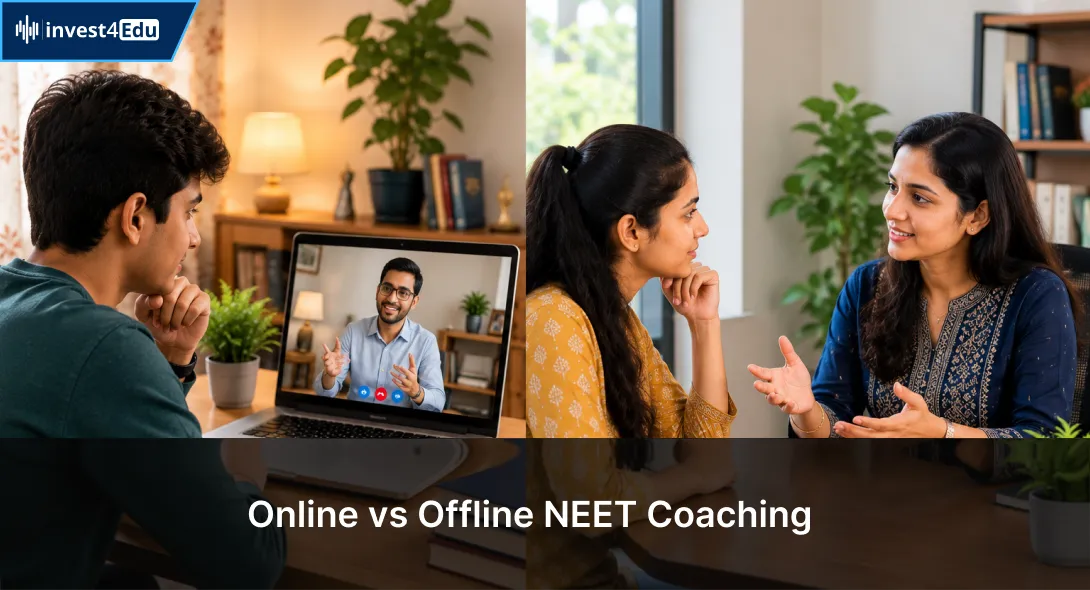





Two students join NEET coaching on the same day. One studies from a bedroom at home. Laptop, headphones, and recorded lectures. The other takes a bus to a classroom six days a week to attend live classes.
Same syllabus. Same number of months. Same goal.
A year later, one clears NEET comfortably. The other is staring at a score that doesn't add up to the effort.
So what went wrong?
Most people will tell you it's about online vs offline NEET coaching. That one mode is simply better than the other. Pick the right one, and you're sorted. That's the wrong way to look at it.
The mode isn't what separated those two students. Something else did. And once you see it, the whole question changes from "which coaching is better" to "which coaching is better for me."
This article breaks down both sides honestly. Costs, discipline, doubt-clearing, distractions. By the end, you won't just know the difference, you'll know which one fits you.
Let's get into it.
Online vs Offline NEET Coaching: Quick Comparison
Before we go deep, here's the honest side-by-side. No spin.
|
Factor |
Online NEET Coaching |
Offline NEET Coaching |
|
Cost |
Low: course fee only |
High: Local institute: fees + daily travel. Relocating (Kota/Sikar/Hyderabad): fees + hostel + mess + travel |
|
Flexibility |
High — study anytime, anywhere |
Low — fixed daily timetable |
|
Discipline |
Self-driven — you hold yourself accountable |
Built-in — the structure holds you |
|
Doubt Clearing |
Delayed — chat, forums, scheduled sessions |
Instant — raise your hand, get an answer |
|
Peer Competition |
Limited — mostly virtual |
Strong — you see who's ahead, daily |
|
Revision |
Easy — rewatch recorded lectures anytime |
Varies — only if your institute records classes |
|
Faculty Access |
Top national teachers, location no bar |
Depends on your local institute |
|
Distraction Risk |
High — your mobile is right there |
Low — mobile in the bag during class |
Read the table closely, and a pattern shows up.
Online NEET coaching wins on flexibility, cost, and revision. Offline coaching wins on structure, doubt-clearing, and competition. Neither one sweeps the board. That's the whole problem with the question "which is better" — the answer is split right down the middle.
Notice the two rows that actually decide outcomes, though. Discipline and distraction risk. Every other factor is a convenience. These two are about whether you'll actually do the work. Hold that thought, it's the thread that runs through the rest of this comparison.
So the real NEET coaching comparison isn't online vs offline. It's structured learner vs self-directed learner. And that's where we go next.
The Real Question Isn't Online vs Offline
Go back to those two students for a second.
The one who failed wasn't lazy. They studied hard, on the good days. The problem was nobody noticed the days they didn't.
The real question is simpler, and a little uncomfortable: What kind of learner are you when no one is watching? Because that splits every NEET aspirant into two groups.
- Self-directed learner: Give them a syllabus and a deadline, and they build their own routine. They don't need a teacher standing over them. Structure comes from inside.
- Structured learner: Smart, capable, often just as hardworking, but they need the system around them. A fixed timetable. A classroom they have to show up to. Someone who notices when they go quiet. Take that scaffolding away, and the discipline quietly slips.
Neither one is better. This isn't about being weak or strong. It's about being honest.
Online NEET coaching hands you freedom. For a self-directed learner, that freedom is fuel. For a structured learner, that same freedom becomes the thing that sinks them — the missed lecture, the "I'll do it tomorrow," the study environment that never quite turns serious.
Offline coaching does the opposite. It removes the freedom and replaces it with routine. A self-directed learner can find that suffocating. A structured learner finds it lifesaving.
Same two options. Opposite outcomes. The format didn't decide it. The learner did. So before you compare a single fee or feature, figure out which one you are. Honestly. And if you can't tell, that's exactly what career counselling before NEET is for.
When Online NEET Coaching Wins
Look past the lectures, the app, the low price. Online coaching really suits one person: the self-directed learner.
Freedom is the whole pitch — and freedom only helps if you can handle it. Give a self-driven student a syllabus and no supervision, and they thrive. No commute. No waiting for the class to catch up. They set the pace, and they hold it. For this student, the missing structure isn't a gap. It's the appeal.
It erases geography. This is online's real superpower, and it has nothing to do with cost. Distance used to decide your teachers. Now, a small-town student learns from the same faculty as anyone in Delhi or Kota. Where you live doesn't decide who teaches you.
It lets you skip what you've already mastered. In a classroom, everyone moves together whether you need it or not. Online, a student who knows their weak spots can spend time only where it's needed and breeze past the rest. For someone who studies by self-diagnosis, that's hours back every week.
Put simply, online hands a motivated student the keys and gets out of the way. It only works if the student actually drives.
When Offline NEET Coaching Wins
Flip it, and offline is built for the opposite person: the learner who needs the system around them.
Structure isn't a restriction for this student — it's oxygen. A fixed schedule. A room you physically have to reach by 8 am. It quietly removes the hardest decision in NEET prep, the one you make every morning: do I actually study today? For a structured learner, that decision being made for them is the difference between a year that holds and a year that drifts.
The room does something a screen can't. A hall full of people chasing the exact seat you want resets your sense of "enough." You see who's grinding harder, and you can't quietly fall behind without noticing. That pressure, the healthy kind, is one of the most underrated forces in a 12-month cycle.
Someone is actually watching you. This is offline's quietest advantage. A teacher who clocks you slipping in week six and pulls you aside before it becomes week sixteen. That kind of mentoring is hard to get when you're a name in a dashboard nobody checks.
The whole case fits in one line: offline builds discipline from the outside in. It carries the student who can't yet carry themselves.
The Hidden Costs Nobody Adds Up: Online vs Offline NEET Coaching Fees
"Online is cheaper, offline is expensive." Everyone knows that line. Almost nobody does the math behind it. So let's print the receipts.
Receipt one: online coaching
Course fee — online NEET batches start as low as ₹3,200, and a full-year course on Physics Wallah, the most affordable serious option, runs about ₹4,000 to ₹5,000. Fuller programs from other platforms climb into the tens of thousands, but even those pricier online options are still nowhere near as expensive as the offline cost you're about to see.
One line. Paid. Done.
Receipt two: offline coaching
Study locally — coaching fee plus daily travel. Manageable.
But most serious aspirants don't. They relocate. Kota. Sikar. Hyderabad. And the moment they move to the coaching, the receipt stops being one line and starts unspooling:
- Coaching fee — a one-year classroom coaching for NEET at Allen Kota, roughly ₹1.4 lakh
- Hostel — ₹4,500 to ₹12,000, every month
- Mess — another ₹2,000 to ₹3,000, every month
- Travel, books, daily expenses — stacked on top, month after month
All in, a relocated year in Kota lands around ₹3 to ₹5 lakh.
Now hold the two receipts side by side.
Four thousand rupees on one. Three lakh-plus on the other. Same syllabus — the same NCERT for everyone. Often the same calibre of faculty. Same exam at the end.
So, is offline a rip-off? No. Kota has produced thousands of NEET toppers, and for the right student, that environment earns its cost. We covered exactly who two sections ago. The point isn't that offline costs too much — it's that nobody hands you the second receipt before you sign.
But here's what catches everyone. Online prints a second receipt too. It just doesn't arrive at checkout.
That ₹4,000 buys the lectures, the tests, the material — everything you need. What it doesn't buy is the discipline to use them. For a self-directed student, that's no problem; they'd have studied anyway, and online just handed them the same prep for a fraction of the price. For a student who needs structure, that same ₹4,000 can quietly turn into hours lost to a mobile that's always within reach. Same course, same price — two completely different outcomes.
So neither receipt is the "expensive" one. Offline charges whoever signs up, up front, in money. Online charges only the student who can't drive themselves, later, in focus.
Offline costs your parents' wallet. Online costs your study hours — if you let it. Pick the receipt you can actually afford to pay.
Which Mode for Which Student?
Enough psychology. Let's get specific.
Forget the generic label. You're at a particular stage, with a particular weakness, in a particular town. Five situations. Five honest verdicts. Find yours.
Class 11 beginner → Offline
This is the year your foundation gets built, and the worst possible year to be managing yourself alone in a bedroom. You don't yet know which concepts are hard, so you can't know what you're missing. Let the classroom carry the structure until you've built your own. Online-only at this stage is the setup most likely to quietly fall behind.
Class 12 student → Depends on how Class 11 went.
Solid base and a routine you can run yourself? Online works now — you know your weak spots and can target them while juggling boards. Shaky foundation? Stay offline. Class 12 is not the year to discover you needed supervision all along.
Dropper → Mostly online, with one warning
You've seen the syllabus. You don't need Class 11 Biology again; you need targeted revision, test series, and the freedom to skip what you've mastered. Online delivers exactly that, cheaper. The warning: a drop year is isolating and brutal. If your motivation collapses without people around you, go hybrid — online's efficiency, offline's structure to hold you up on the bad days.
Easily distracted → Offline. No debate
Be honest with yourself here. If your mobile wins most days, online hands the mobile your entire education — the lecture lives on the same screen as Instagram. Offline puts a wall between you and that screen for six hours a day. For you, that wall is worth more than any feature.
Small-town student → Online, and it's a genuine equaliser
You used to be stuck with whatever local coaching existed, or forced to relocate and pay the Kota bill we just broke down. Now you sit in the same virtual class as a topper in a metro, taught by the same faculty, from home. No relocation, no hostel, no lakhs gone. Online doesn't just compete here; it erases the geographical disadvantage.
Spot it? Not one verdict came down on which mode is "better." Every single one came down to where you are and how you work. That's what the evidence points to, compressed into five answers.
Do NEET Toppers Prefer Online or Offline Coaching?
This is the one everyone actually wants answered. So let's run the experiment.
Line up the toppers from any recent year, side by side. Now look for what they have in common.
Start with coaching mode — the thing you came here to check. The line falls apart immediately. One studied at Allen in Kota. One never left her hometown, just a laptop and recorded lectures. One did a year of each. Some thrived in a packed hall; some sat alone at a desk at 2 am. No pattern. The "mode" column is just noise.
Frustrating, isn't it? You wanted a winner. Keep scanning, though. Because there is one column where every single one of them matches.
They showed up. Every day. Online or offline, the topper is the one who did the work, whether or not anyone was watching. The online one wasn't drifting to YouTube. The offline one wasn't just warming a seat. Same trait, two settings.
That's the underlying pattern — proven by the people at the very top.
So, can online coaching produce a NEET topper? It does, every year — the success rate of online NEET coaching has climbed as the platforms mature. Can offline? Same answer. Because neither mode is the thing doing the work. The student is.
The one thing that actually carried them was never on the price list. It's a habit. You build it, or you don't. So stop studying which platform the rankers picked. Start studying what they did with it.
The NEET CBT Shift: Does It Change the Answer?
The NEET exam itself is going online. On May 15, 2026, the Education Minister confirmed that NEET-UG moves to computer-based test (CBT) mode from 2027, replacing pen-and-paper OMR. The trigger was the paper leaks. The review committee flagged the OMR system itself as the weak link. The June 21, 2026, re-exam stays on paper; the shift starts in 2027, and only the mode changes — the NCERT syllabus stays exactly the same. The formal NTA notification is still pending, so treat it as all but final.
So the real question stops being online or offline. It becomes: does your coaching actually put you in front of timed, on-screen mocks, again and again, before exam day? That's the new dividing line — and the institutes that build it in, whatever their mode, are the ones that'll send students in ready.
The Rise of Hybrid NEET Coaching
By now, you might be asking: why pick a side at all? Take offline's structure and online's flexibility, and stop treating them as enemies. That's hybrid — and it's where the market is moving.
On paper, it's the obvious answer. Classroom for routine, recordings for revision. Show up for discipline, log on for flexibility.
But "best of both" cuts both ways. Used well, you're caught twice — the classroom catches you when discipline slips, the recordings catch what you missed. Used lazily, both fail in the same spot: you skip the class ("it's recorded anyway"), then never watch the recording. Two safety nets, same hole, and you drop through the middle.
So hybrid isn't a free win. It rewards the student honest enough to use both halves — and quietly traps the one who treats each as an excuse to skip the other.
The bigger picture: faculty quality has levelled out, and the exam is going CBT. The line between "online student" and "offline student" is already blurring. Hybrid is just the market saying so out loud — and proof, again, that it was never about the mode.
So, Which Should You Choose?
Everything so far, in one place. Find the row that sounds most like you.
|
If you are... |
Lean toward |
|
Self-disciplined, run your own routine |
Online |
|
Someone who needs structure to stay on track |
Offline |
|
A dropper who already knows the syllabus |
Online (hybrid if motivation dips) |
|
A Class 11 beginner building a foundation |
Offline |
|
Easily pulled in by your mobile |
Offline |
|
In a small town, far from good institutes |
Online |
|
Fed by competition around you |
Offline |
|
Tight on budget |
Online |
|
Wanting structure and flexibility both |
Hybrid |
Read the table, and the trick is obvious: not one row asks which mode is better. Every single one asks who you are. Same question, nine angles.
And if you fit two rows pulling opposite ways — say you're self-disciplined, and you feed off competition, that's not a contradiction. That's the exact student hybrid was built for. Take structure where you're weak, flexibility where you're strong.
Use this as a starting point, not a verdict. It tells you where to lean. Your own honesty about how you actually study tells you where to land.
Final Thoughts
So, online or offline NEET coaching, what works better? Neither. And both.
The best coaching for NEET preparation isn't the one with the biggest building or the slickest app. Not the one with the most toppers on its banner or the highest fees on its brochure. Those things sell. They don't decide your rank.
What decides it is smaller and harder: whether you do the work on the days nobody's watching. Whether you're honest about the learner you are, not the one you wish you were. So don't ask which coaching is better. Ask which one is better for you — then pick the setup that fits.
Still unsure whether you're a self-directed or structured learner? A personalized NEET counselling session can help identify the coaching format, preparation strategy, and college pathway that fits your learning style before you invest a year and lakhs of rupees.
Whichever mode you choose, follow the one habit that survives every success story: keep showing up, keep studying, and keep moving forward.