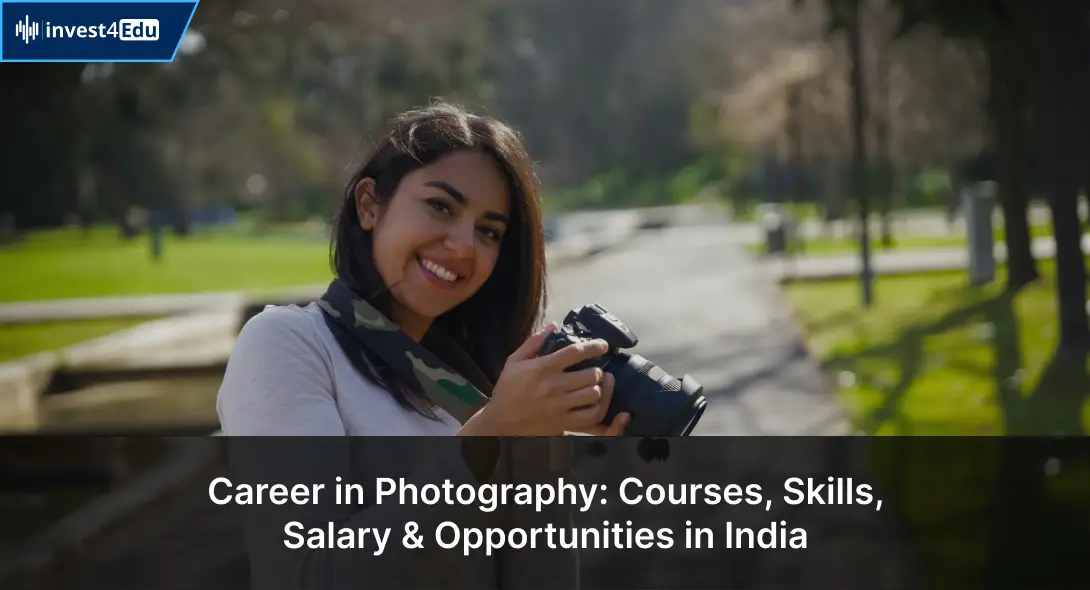





Most people start photography with a phone or a hand-me-down camera, chasing a good frame. The real gap is what comes after: turning that into an actual career.
Photography today is not limited to weddings and studio work. Photographers are also working with brands, e-commerce businesses, media companies, fashion teams, and advertising agencies. So there are more directions to explore if you are seriously considering photography as a profession.
But knowing that opportunities exist doesn't make choosing a path easier. You still have to figure out which photography courses make sense, what skills you need, what kind of salary you can expect, and which career opportunities in photography in India are worth exploring. That's what we'll look at here.
Photography Career at a Glance
| Aspect | What to Expect |
|---|---|
| Entry routes | Short certificate, diploma, full degree, or self-taught + portfolio |
| Typical course duration | A few weeks for short courses to 3-4 years for a bachelor's degree |
| Common eligibility | Varies by course; some certificate and diploma programmes accept Class 10, while bachelor's programmes usually require 10+2 |
| Reported average salary | Around ₹19,000 per month, based on Indeed India data |
| Freelance project rates | Vary widely by assignment and niche; see Salary section |
| Popular specializations | Wedding, commercial/product, fashion, food, travel, wildlife, sports, photojournalism |
Who is a Photographer?
A photographer is someone who takes photographs for a living or as part of their work, which is about the simplest photographer definition you'll find. If you're wondering who photographers are and what they actually do, the answer depends a lot on the kind of photography they work in. Weddings, products, fashion, wildlife and forensic work, for example, all need a different way of working behind the camera.
What does a photographer do beyond taking pictures? There is usually some preparation before a shoot and editing afterwards. Depending on the assignment, a photographer may also work on lighting, framing and selecting the final images. Freelancers have a few more things to handle, such as speaking with clients, scheduling shoots and managing payments.
What Life as a Photographer Looks Like
Ask photographers about a typical week, or why they entered the field in the first place, and the answers often come back to creative work, travel, independence or simply enjoying the process of making images. For a student thinking, “I want to be a photographer because I enjoy telling stories through pictures,” the day-to-day reality can also include project schedules, client discussions, deadlines, editing and travel, depending on the niche. The life of a photographer, in other words, tends to look more like running a small business than people expect going in.
Why Choose Photography as a Career in India?
If you are considering a career in photography in India, the options are no longer limited to the traditional studio, wedding or newspaper route. In India, the photography industry extends across journalism, e-commerce, advertising, scientific and forensic work, weddings, hospitality, real estate and digital content. The use of photography changes with the sector: it may document news or evidence, present a product, market a property or create campaign imagery, and these different uses of photography create career routes across studios, production houses, media and advertising agencies, e-commerce teams, wedding companies and freelance work.
- More sectors use photography. E-commerce businesses, D2C brands, media teams and advertisers need product, catalogue, campaign and lifestyle imagery.
- The first few assignments may be small ones. They still give you work for your portfolio and a chance to learn what dealing with real clients is like.
- Weddings and events are an established route. Photographers may work on weddings, pre-wedding shoots, portraits and event coverage.
- Freelancing and business ownership are possible paths. Some photographers take independent assignments, while others eventually build a studio or photography business.
- The same core skills work across several niches. Lighting, composition and editing are useful in areas ranging from weddings and commercial shoots to in-house media work.
Photography can still be competitive, and freelance income may be uneven, especially early on. The advantage is choice: photographers can work across several sectors and employment models.
Types of Photography Careers You Can Choose From
There are many types of photographers, and the work can look completely different from one field to another. What you shoot, where you work and even how you earn can change with the niche. Here are some of the main photography careers to know.
- Wedding Photography Weddings are one of the most familiar routes into professional photography in India. The work can include the wedding day itself, pre-wedding shoots, candid photography and couple portraits. Referrals are especially important in this field.
- Fashion Photography Interested in clothes, styling and working with people? Jobs in fashion photography can involve model portfolios, brand campaigns, lookbooks and editorial shoots. Mumbai and Delhi are two of the major centres for this kind of work.
Wildlife Photography A career in wildlife photography is very different from studio work. You may spend hours waiting for a single shot, travel frequently and work in changing outdoor conditions. Knowing your equipment helps, but patience matters just as much. - Travel Photography There isn't always a fixed employer here. Jobs in travel photography may come from hotels, tourism companies, publications or individual assignments. Some photographers also license their travel images or sell them through stock platforms.
- Sports Photography Timing matters more than anything else in sports. Photographers need to follow the action and capture moments that may last only a second. A career in sports photography can lead to work with teams, leagues, publications and sports media.
- Commercial Photography Products, advertisements, company websites and catalogues all need photographs. That's where jobs in commercial photography come in. This field includes product photography, corporate shoots and advertising work.
- Food Photography Food photography is not simply about taking a picture of a finished dish. Lighting, plating and styling all affect the final image. A career in food photography can involve restaurants, food brands, publishers and advertising teams.
- Forensic Photography This is a more specialised route. Jobs in forensic photography involve accurately recording scenes or evidence for investigative and legal purposes. The focus here is documentation rather than creative styling.
- Photojournalism Photojournalists tell news stories through photographs. They may cover people, events, public issues or breaking news for media organisations. Students interested in this route can also look at photography journalism courses and invest4Edu's News Photographer career profile.
- Architecture & Real Estate Photography Here, buildings and spaces are the subjects. Jobs in architecture and real estate photography can include property listings, hotels, interiors and work commissioned by architects or real estate companies. Perspective and lighting are especially important.
There are other routes too, including portrait, product, event, newborn and fine art photography. You don't necessarily have to decide on one immediately. Many photographers try different kinds of work before settling into a particular niche.
How to Become a Photographer in India
People get into photography in different ways. A course is one option, but it isn't the only one. Some learn while assisting another photographer, while others begin by practising and taking up small shoots.
1. Spend some time on the basics. Before buying more gear, get used to exposure, lighting and composition. Practise with the phone or camera you already have and see how changing each one affects the picture.
2. See what kind of photography you enjoy. Try different subjects before choosing a niche. Portraits, events, products, street photography or nature shoots can all help you understand what you are naturally drawn to.
3. Decide whether you need a course. A short certificate course can be useful if you're still testing your interest. A diploma in photography gives you more time to practise, while a degree is the more formal academic route. We compare these options in the next section.
4. Start putting your best work together. Keep the photographs you would actually be comfortable showing a client. As your work improves, remove the weaker ones and add better shots.
5. Get some experience outside the classroom. You could assist a photographer, take up a few small assignments or work on your own projects. This is where you begin dealing with real shoots, deadlines and client expectations.
6. Don't forget the work around the shoot. Freelancers also have to quote prices, talk to clients, fix shoot dates and deal with basic contracts. These things become part of the job once paid assignments start coming in.
7. Your niche doesn't have to stay the same. You may begin with one kind of photography and later find that another suits you better. That can happen naturally as you take on more work.
Photography Courses in India
Not every photography course follows the same route. You might find a short certificate that finishes in a few weeks, a diploma that takes several months or longer, or a degree that runs for three to four years. So it helps to first decide how much time you are ready to commit.
Types of Photography Courses & Duration
| Course Type | Typical Duration | Best For |
|---|---|---|
| Foundation / Certificate Course | A few weeks to 1 year | Beginners testing interest or building basic skills |
| Diploma in Photography | About 9 months to 2 years | Students wanting longer practical training without a full degree |
| Bachelor's Degree (BA/BSc in Photography) | 3-4 years | Students wanting formal, university-backed study |
| Specialized Short Courses | A few days or weeks to a few months | Niche skills such as fashion, product, lighting or video |
| Online Courses | Self-paced | Flexible learners and students testing interest |
There is plenty of choice between these formats. A short course may work better alongside college or a job, while a diploma or degree needs more time. Some courses also mix online and classroom learning, and shooting and editing may be taught as part of the same programme.
Courses After 10th & 12th
Photography isn't limited to after-degree study. Some certificate and diploma programmes accept students after Class 10, while bachelor's programmes generally require 10+2. After 12th, students can choose between short courses, diplomas and degree programmes depending on how much time and formal training they want. If you're comparing photography courses after 12th, look at faculty, equipment access, curriculum and student portfolios, not just fees.
Free Online Photography Courses
For students looking for photography courses free online, these platforms can be useful starting points:
- YouTube – Free photography tutorials are available on topics such as camera basics, lighting, composition and editing.
- Coursera – Some courses offer free preview access, although certificates generally require eligible paid enrolment.
- edX – Many courses can be audited at no cost, while verified certificates are usually part of the paid track.
- Udemy – Offers photography courses at different price points, with access and pricing depending on the individual course.
If you're searching for photography courses online for beginners, compare the syllabus, level of access and certificate terms before choosing a course.
Course Fees in India
Photography course fees in India vary widely by course length and institute. Short courses may cost a few thousand rupees, while diploma and degree programmes can run into lakhs. Registration, GST, equipment or residential charges may be separate. The verified examples below give a clearer idea of current fees.
A Few Verified 2026 Examples
These examples are taken from current institute pages rather than aggregator listings:
| Institute | Course | Fee (as listed) |
|---|---|---|
| DCOP | Basic Photography (2 weeks) | ₹4,999 + GST |
| SACAC | Fundamentals of Photography (5 weekends, 32 hours) | ₹16,000 + applicable GST |
| MIT-WPU | BA Photography (Hons.), 4 years | ₹2.80 lakh per year |
| SSVAP | BA in Visual Arts & Photography, 3 years | ₹4.4 lakh per year |
Course Eligibility & Admission
Entry requirements are different for each course. These examples from the institutes' own websites give a better idea of what students may come across:
- DCOP: The 2-week Basic Photography course has no age limit. Its Diploma in Commercial Photography currently lists Class 10 as the eligibility requirement.
- Hamstech: Class 10 is enough for its Certificate Course in Photography. Its BA (Hons.) Degree Course in Photography requires 10+2.
- SSVAP: SSVAP keeps 10+2 as the basic requirement for its BA in Visual Arts & Photography. Students also need to share a photography portfolio and appear for an interview.
- SACAC: Its Fundamentals of Photography course currently lists eligibility as age 15+.
How to Choose the Right Photography Course
Not every course will suit the same student, so it helps to compare a few practical things before you decide.
- Match the format to your goal. A weekend or short course can help you test your interest; a diploma or degree gives you more time for structured training.
- Check who's actually teaching. Look at faculty profiles and whether working photographers are involved in the programme.
- Ask about equipment access. Find out whether studio time, lighting gear and camera access are included in the fee or charged separately.
- See what past students have done. Look through recent student portfolios and ask the institute about placements rather than relying only on promotional material.
- Confirm the fee is complete. GST, registration, equipment or residential costs may be separate from the headline tuition fee.
Photography Courses by City in India
For a quicker comparison, the main city-wise options are grouped below. Course names and durations can change, so check the institute directly before applying.
| City | Institutes & Course Options |
|---|---|
| Delhi |
|
| Bangalore |
|
| Chennai |
|
| Pune |
|
| Kolkata |
|
| Hyderabad |
|
| Mumbai |
|
Government & Nationally Recognized Institutes
Students who prefer a government or nationally recognised institute have a few options to look at. AJK Mass Communication Research Centre at Jamia Millia Islamia offers a PG Diploma in Still Photography & Visual Communication over two semesters. NID Gandhinagar offers a 2.5-year M.Des in Photography Design.
Skills Required for a Photography Career
Knowing how to use the camera is only one part of the job. Once you start taking up assignments, you also have shoots to plan, images to finish and clients to deal with.
Technical Skills
| Skill | Why It Matters |
|---|---|
| Camera & exposure control | Understanding ISO, aperture and shutter speed gives you more control over the final image |
| Composition & lighting | Helps you decide how the subject, light and frame work together |
| Photo editing | Lightroom, Photoshop and similar tools are commonly used for editing and retouching |
| Gear knowledge | Knowing how to use lenses, flashes and other equipment for different shoots |
| Niche-specific techniques | Studio lighting for portraits, fast autofocus for sports, and close-up techniques for product work |
Business & Soft Skills
If you work independently, there is also a client side to the job that you have to manage yourself.
- Client communication – understanding briefs, discussing expectations and handling feedback
- Portfolio building & self-marketing – presenting your work online and showing potential clients what you can do
- Pricing & negotiation – quoting for assignments and discussing project terms
- Time & project management – keeping shoots, editing and delivery dates on track
- Networking – building professional contacts and staying connected with clients and others in the industry
Modern Workflow Skills: Editing, Video and AI
Photography jobs don't always stop with taking the picture. Some current roles also ask for photo editing and basic video skills, and the two may be bundled together in the same job. AI-assisted editing tools are also being used for tasks such as background removal, retouching and other repetitive editing work.
How to Build a Photography Career Portfolio
A photography portfolio gives clients or employers something concrete to look at before they decide to work with you.
- Try a few projects of your own. Pick subjects that are close to the kind of work you may want to do later. Someone interested in product photography, for instance, will build a very different portfolio from a wedding or wildlife photographer.
- Don't keep every photograph you take. Choose the ones you would actually be comfortable showing a client, and leave out images that feel repetitive or weaker. A focused portfolio is more useful than adding photographs simply to make it bigger.
- Look for some real-world experience. Assisting a photographer or taking up a few small assignments can help you understand how shoots, clients and deadlines work outside a course.
- Make your work easy to see. You can put your photographs on a simple website or portfolio page. You can also use social media to share recent work and help more people come across it.
- Stay in touch after a good project. A satisfied client may be willing to recommend you or give you a testimonial that you can use when approaching future clients.
Photographer Salary in India
Photography income doesn't follow one fixed pattern. Someone working for a company may have a regular monthly salary, while freelance income depends on the assignments that come in. Indeed India currently reports an average photographer salary of around ₹19,000 per month in India.
Salaried vs. Freelance Photography
If you work for a studio or company, your pay usually comes as a monthly salary. Freelance work is different because you may charge by the shoot, day or package, and the number of assignments can change from month to month. Project charges also shouldn't be treated as take-home income because travel, equipment, editing and other business costs may come out of that amount.
Freelance Photography Charges
Freelance photography charges do not follow one standard rate in India. Pricing can change depending on the type of assignment, location, photographer's experience, shoot duration, editing requirements and final deliverables.
Wedding and event photographers may charge by the day or package, while commercial, product and fashion photographers may price work by the project, image or campaign.
Project charges should not be treated as take-home income. Travel, equipment, assistants, editing and other business costs may come out of the amount a client pays.
Does Location Affect Salary?
To some extent, yes. Demand, the type of employers active in a city and typical project budgets can vary by location, so earnings for similar photography work may differ from one city to another.
Job & Career Opportunities in Photography
Photography opportunities today go beyond studios, weddings and newspapers. Current photography positions in India include product and e-commerce photography, wedding and event work, photographer-videographer roles, photo editing and commercial shoots. Many roles also expect photographers to handle at least some editing or video work along with still photography.
Where Photographers Work
- E-commerce and retail brands – product, catalogue and lifestyle photography
- Wedding and event companies – wedding, pre-wedding and event coverage
- Real estate and interiors – property, architecture and interior photography
- Food and hospitality businesses – food, restaurant and brand imagery
- Media and creative agencies – editorial, commercial and visual-content work
Employment Paths
There isn't one fixed work setup in photography. Some photographers have regular jobs with studios or companies. Some take freelance shoots, while others go on to open a studio of their own.
Photography Careers Beyond Shooting
Photography knowledge can also be useful in roles where taking pictures is not the main responsibility:
- Photo Editor / Retoucher – selecting, correcting and retouching images
- Studio or Production Coordinator – helping organise shoots, schedules and image delivery
- Art Director / Creative Producer – planning the visual direction of campaigns and shoots
- Photography Instructor / Faculty – teaching photography through institutes or workshops
- Image Researcher / Licensing Professional – finding, organising and managing image rights
- Digital Asset or Image-Production Roles – managing image libraries and production workflows
Conclusion
Photography can begin as an interest, but building a career from it takes time and practice. The course you choose is only one part of it. The kind of photography you work on, the portfolio you build and the experience you pick up along the way will also shape where you go next.
There is no single route into the profession. You might work with a studio or company, take up freelance assignments or eventually build a photography business of your own. What matters is finding the route that fits your interests and the kind of work you want to do.
If photography interests you but you're still unsure about the right course or career path, invest4Edu's Career Counselling can help you understand your strengths, compare your options and plan what to do next.